


For many students at the University of Ghana, securing accommodation is no longer simply a matter of finding a place to sleep. It has become a critical financial decision that determines how comfortably, or how precariously, they navigate university life.
Behind every accommodation fee is a student whose finances are already stretched by tuition, transportation, food, learning materials, and other essential expenses. Some rely on parents and guardians making difficult financial choices, others depend on personal savings, loans, or part-time work to meet their expenses.
Against this backdrop, the proposed increase in residential fees at University of Ghana Enterprise Limited (UGEL) facilities has sparked renewed concerns about the affordability of student accommodation. The controversy has also drawn the attention of the Rent Control Department, placing the issue at the intersection of student welfare, institutional decision-making, and the enforcement of Ghana’s rental laws.
The core question is no longer merely whether accommodation fees should increase, but whether the process, timing and scale of such increases adequately consider the people expected to pay them.
The controversy intensified after an initial proposal for a 26 percent increase in accommodation fees at university-managed halls and facilities operated by UGEL was rejected by student leaders.
According to a report by Citi News, University of Ghana Dean of Student Affairs, Professor Rosina Kyerematen, explained that subsequent discussions resulted in revised increases of 15 percent for four-per-room occupancy and 19 percent for two-per-room occupancy.
However, the revised figures have not entirely resolved students’ concerns. The distinction between the original proposal and the revised rates is important; it would be inaccurate to suggest that the University simply imposed the original 26 percent proposal without modification. Yet, the fact that the proposed increase was revised does not automatically settle the question of affordability.
A percentage increase may appear modest when considered in isolation, but its real impact depends on base costs, household income and the quality of accommodation delivered in return. For a struggling family, even a smaller increase creates a significant hurdle. Campus housing is not a luxury; it is a fundamental requirement for a stable academic experience.
When the cost of securing a room rises, students may be forced to seek additional financial assistance, relocate farther from campus, or cut back on essential living expenses. Those living off-campus face additional transportation costs, often offsetting whatever savings they hoped to make on rent. The consequences extend beyond hostel receipts; they directly affect the conditions under which students learn.
The planned demonstration and the limits of dialogue
The accommodation dispute has also generated calls for direct student action. The Concerned Students’ Movement of the University of Ghana announced plans to demonstrate against the proposed increases, demanding fee reviews, refunds for students who already paid and greater transparency in decision-making.
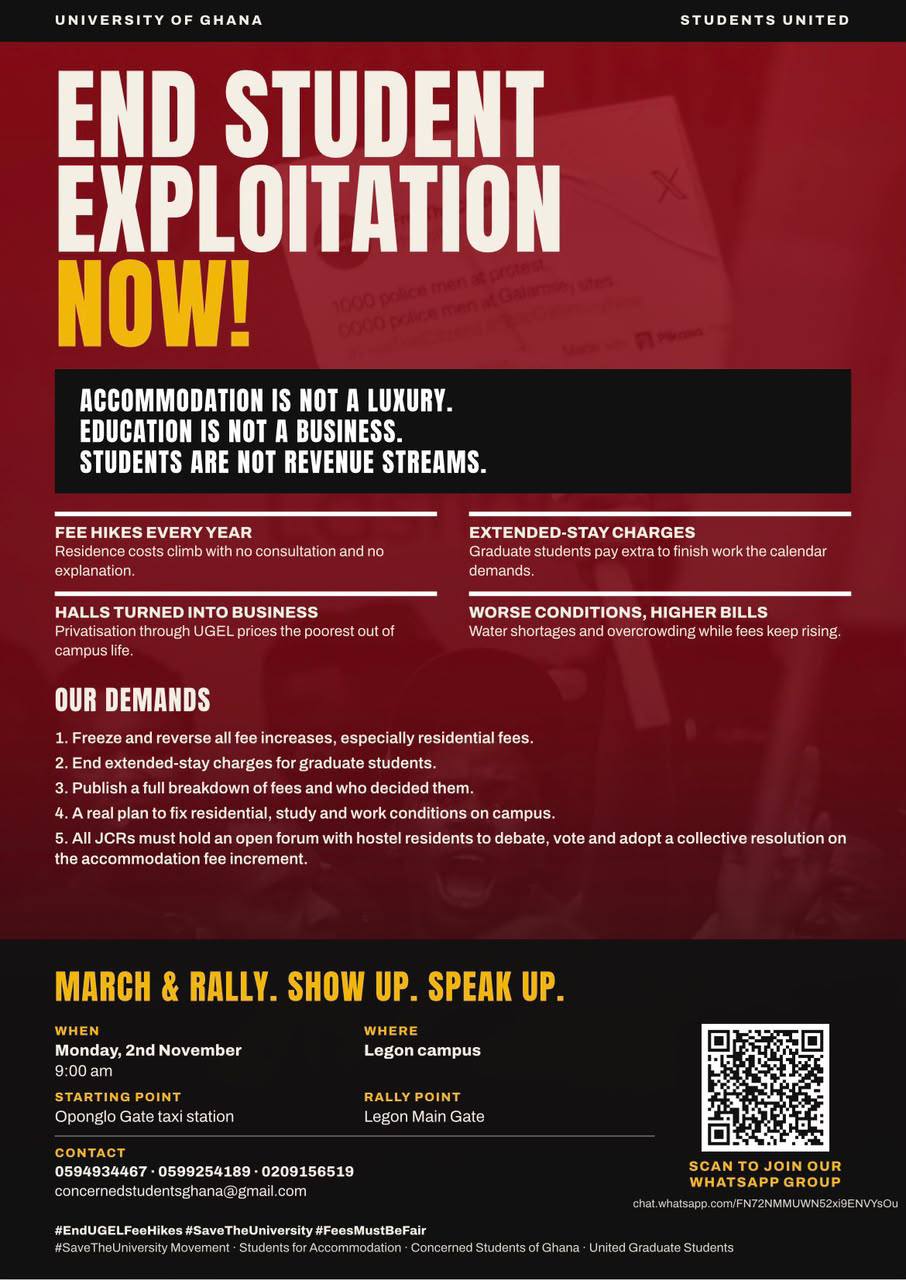
However, the planned protest highlighted tension over advocacy methods. In a joint communiqué issued on 1 November, the University of Ghana Students’ Representative Council (UGSRC) and the Graduate Students’ Association of Ghana (GRASAG-UG) cautioned students against participating, citing the group’s unrecognised status alongside public safety and disciplinary concerns. Crucially, the SRC and GRASAG acknowledged that affordability concerns remain legitimate. Disagreement over protest tactics should not be mistaken for an absence of real grievances.
University management and student leaders must maintain order, just as students have a legitimate right to voice concerns about their welfare. A planned demonstration should neither be an excuse to dismiss valid student concerns, nor a reason to disregard lawful procedures and safety.
The Rent Commissioner versus UGEL
The dispute expanded into national view following the intervention of Acting Rent Commissioner Frederick Opoku. On 29 October, reports indicated that the Rent Control Department had warned against unapproved fee increases and was considering legal action, including seeking an injunction based on advice from the Attorney-General.
The Rent Control Department subsequently issued a directive ordering UGEL and affected private hostel operators to suspend unassessed rent increases, restore previous rates, and refund excess payments collected from students by 17 November 2026. Citing the Rent Act, 1963 (Act 220) and the Rent Control Act, 1986 (PNDCL 138), the department maintained that student housing facilities are not automatically exempt from national rental laws.
This intervention shifts the discussion from affordability alone to legal compliance. However, a regulatory directive remains distinct from a final judicial determination. The exact application of rental law to institutional facilities must ultimately be evaluated within the proper legal framework. Still, the directive raises questions that accommodation providers cannot ignore.
If statutory assessment is required before rent adjustments take effect, an institution’s educational mandate does not grant automatic exemption. Equally, regulatory enforcement must remain fair, consistent, and grounded strictly in law—not public pressure alone. No institution is beyond scrutiny, but none should be declared culpable without due process.
This controversy points to a broader conversation about tertiary education equity. Access requires more than an admission letter and paid tuition; it requires living conditions that allow students to focus on their studies. When accommodation costs escalate, access becomes unequal, favoring those with financial cushioning while placing extra burdens on the rest.
Beyond the controversy, students need answers
The disagreement between UGEL and the Rent Commissioner, the concerns raised by students and the debate surrounding the planned demonstration all point to the same underlying issue: decisions about student accommodation require greater transparency and accountability.
The Rent Control Department directive has established a clear expectation for affected operators, including the suspension of unassessed increases and the refund of excess payments by 17 November. Compliance should be monitored, and students should be able to report concerns without fear of intimidation or unfair treatment.
UGEL should provide clear explanations of its residential charges and demonstrate that its decisions follow applicable legal and institutional procedures. University management must also continue engaging students and communicating outcomes clearly, while student leaders ensure student welfare remains central to negotiations.
Students deserve a process where their concerns are addressed constructively rather than dismissed. The goal should not be to turn university management, UGEL, and the Rent Control Department into opposing camps in a prolonged public dispute, but to reach a fair, lawful resolution that protects students while keeping facilities viable.
A demonstration may bring temporary spotlight to campus housing, but real progress will be measured after public attention fades. Whether operators comply with the Rent Control directive, provide transparent fee structures, and ensure accommodation does not block student success requires more than statements of concern—it demands accountable action.
A university education should challenge students intellectually, not force them into a constant struggle for basic housing. Accommodation providers must maintain facilities, regulators must enforce laws and university management must make decisions that withstand scrutiny. But students must not bear the burden of unconsulted financial decisions. A roof over a student’s head should serve as the foundation of their university experience, not another barrier to earning a degree.
–
Story by Chrispin Nhyira Agyekum | univers.ug.edu.gh
Edited by Vanessa Katrin Ohene