
From the moment the referee’s whistle pierced the night air at the Lusail Stadium on Sunday, December 18, 2022, it was clear this would not be an ordinary final.
Right from the first minute of the 2022 FIFA World Cup final, Argentina seemed to be driven by an invisible force.
Calm, confident, fearless. France, champions four years earlier, were pinned back early, watching sky-blue and white shirts pass with purpose and hunger.
Argentina controlled the rhythm. Every touch spoke belief.
In the 23rd minute, the breakthrough came.
Ángel Di María surged into the box, and Ousmane Dembélé, stretched and desperate, clipped him from behind.
The referee pointed to the spot without hesitation. Silence fell. Lionel Messi stood over the ball — years of hope resting on one kick.
He sent Hugo Lloris the wrong way. Argentina led. The dream had begun to breathe.
France barely found footing before Argentina struck again.
In the 36th minute, a move carved from brilliance unfolded.
Messi sparked it, Julián Álvarez carried it, and Alexis Mac Allister threaded the final pass.
Di María arrived like destiny itself, sliding the ball beyond Lloris. Two goals. Argentina soared. France were stunned into submission, their stars invisible, their bench restless.
At halftime, the trophy felt closer than ever.
But football never ends when you think it should.
France returned with urgency, and with Kylian Mbappé waiting like a storm.
Argentina retreated instinctively, guarding their lead, guarding history. Time ticked. The clock teased certainty.
Then, in the 80th minute, everything shattered.
Nicolás Otamendi brought down Randal Kolo Muani in the box.
Penalty. Mbappé stepped up and smashed it home. Before Argentina could steady themselves, France struck again — thirty seconds later. Mbappé, once more, volleyed fiercely past Emiliano Martínez. In the space of a breath, a 2–0 lead vanished. The final was reborn.
Two–two. The stadium trembled. The world gasped.
Extra time arrived, heavy with fear and possibility.
Argentina, refusing to fade, pushed again.
In the 108th minute, Messi pounced in the box after Lloris spilled a save.
The captain bundled the ball over the line. He ran, arms wide, eyes wet. Argentina were ahead again. Three–two. Surely now.
But fate had more ink.
In the 117th minute, a shot struck Gonzalo Montiel’s arm. Another penalty. Mbappé, ice-cold, completed his hat-trick. Three penalties. Three goals. Three–three. Football stood breathless before the abyss.
And when the world thought it had seen everything, football held its breath one last time.
In the 120+3rd minute of extra time, France came within inches of snatching the World Cup. Randal Kolo Muani surged forward and struck — a shot that seemed destined for history.
But Emiliano Martínez, with reflexes born of instinct and steel, leapt and blocked it with a perfectly timed left leg.
What would have been the winning goal was denied, preserving Argentina’s fragile dream when defeat seemed inevitable.
It was a moment that changed destiny.
A heartbeat that separated heartbreak from glory. In that instant, Martínez did not merely stop a shot — he kept a nation’s hope alive.
Then the final whistle blew. No winner. Only penalties.
Mbappé scored first. Messi responded.
Then Emiliano Martínez rose.
He saved Kingsley Coman’s penalty. He stared down Aurélien Tchouaméni, whose shot drifted wide. Argentina never missed. Every kick struck with faith.
Finally, Gonzalo Montiel stepped forward — the same man whose hand had conceded the penalty minutes earlier. Redemption waited. He struck low. The net rippled.
And in that instant, the world stopped, Argentina won 4-2 on penalties.
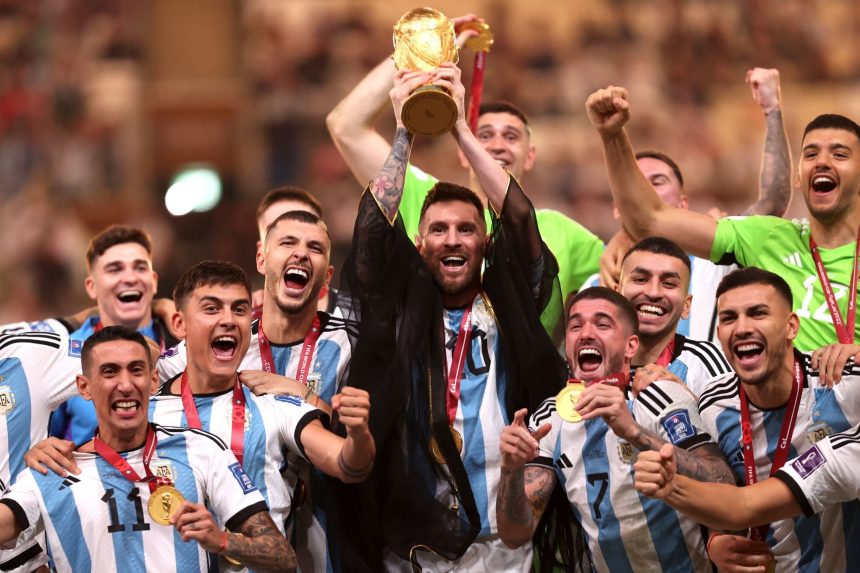
Argentina were champions of the world.
Players collapsed. Messi sank to his knees. Tears flowed freely — from fans, from fathers, from a nation that had waited 36 years for this moment. Under the Qatari sky, Argentina touched the summit of football once more.
December 18, 2022 was not just a final.
It was a story of belief, heartbreak, resilience, and ultimate redemption — the kind of night only football can create.
–
Story by Erica Odeenyin Odoom | univers.ug.edu.gh