
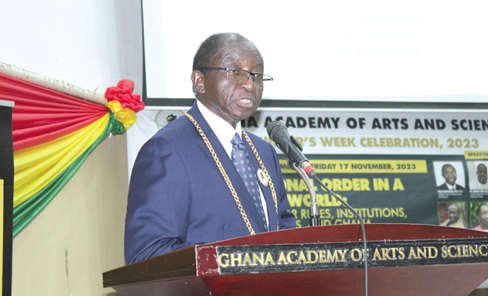
Immediate Past President of the Ghana Academy of Arts and Sciences, Professor Kofi Opoku Nti, has called for a fundamental redesign of Ghana’s agrarian and industrial economy to align with global demands and fully harness the country’s economic potential for its growing youthful population.
He made the call during a public lecture organized by the Ghana Academy of Arts and Sciences under its Humanities Lecture Series, themed “Prospects and Pathways for Economic Transformation in Ghana.” The event explored opportunities and growth prospects as Ghana transitions into a full-fledged middle-income economy.
Speaking at the event, Prof. Opoku Nti highlighted that data from the Ghana Statistical Service and international development organisations show Ghana’s per capita income has stagnated for nearly a decade, hindering the nation’s holistic economic transformation.
“The economy of Ghana, from the colonial era through to independence, has largely depended on the production and export of raw materials to boost foreign earnings. However, this model cannot sustain long-term, transgenerational growth,” he said.
Prof. Nti emphasised that continued dependence on raw material exports, such as cocoa and gold, limits Ghana’s capacity to achieve sustainable development.
“This damning statistic must push state actors to move beyond the production of simple agro products to creating industries where Ghana has a competitive advantage. By investing in value addition — producing semi-finished or finished products — the country can meet global and continental demands, generate higher incomes, and build an economy driven by innovation and technology,” he added.
He further urged the government to identify high-value sectors for targeted investment to propel inclusive economic growth.
“The global economy is highly competitive. Developed nations are not waiting for us to catch up. We need a radical economic reawakening that uses our strengths in resources, minerals, and cash crops to establish scalable manufacturing industries. The success of Malaysia and Indonesia in the oil palm industry offers a clear example of how value addition can transform economies,” Prof. Nti stressed.
He cautioned that maintaining Ghana’s traditional role as a producer of raw materials would continue to keep the nation at the lower end of the global value chain.
“It is not too late to reset the primordial economic model foisted on us since independence — one that positioned us as suppliers of raw materials that fuel the economic turbines of Western powers,” he said.
In a related remark, Chairperson for the event, Emerita Professor Takyiwaa Manuh, attributed the persistent underdevelopment of countries in the Global South to what she termed “closed-source thinking,” where leaders pursue personal ambitions over national development goals.
“The stagnation in development across the Global South is largely due to a mismatch between rational economic planning and the use of natural resources to drive transformation. Leaders must embrace localised models that reflect our realities instead of depending on utopian foreign frameworks,” she said.
Prof. Manuh also called for active citizenship and morally upright leadership that prioritises collective national progress.
The lecture, held on October 30 at the Academy’s premises in Accra, brought together members of the Academy, journalists, and students from Accra Girls Senior High School and Accra Academy, among others.
–
Story by Sika Togoh|univers.ug.edu.gh