


The decision by the University of Ghana to extend graduation medals to all classes, First Class, Second Class Upper, Second Class Lower, and Third Class, has sparked intense debate among students and alumni. While the policy has been championed by Frank Tsikata and his SRC administration, its implementation ultimately rests with the university. Interestingly, this shift marks a return to an older policy that was once abandoned in favour of reserving medals exclusively for First Class graduates. While inclusivity is often a commendable goal, this move risks undermining the values of academic excellence, meritocracy and motivation.
It is worth mentioning that after keeping their transcripts confidential for four solid years and in some cases, even more, many graduates feel uneasy about the lack of privacy on the university’s graduation portal, where anyone can easily check a student’s class by simply entering their surname. Instead of addressing such pressing concerns, which are shared by a majority of students, the SRC prioritised the “medals for all” agenda—an uncalled-for policy that undermines the prestige of academic achievement.
As someone making this argument, I am aware of the criticisms it might attract, claims that I seek exclusivity as a First Class graduate or that the medal holds little practical value. Additionally, some will argue that a distinction has already been made for First Class medals, so there is no need for further debate. These arguments, as I will demonstrate later, fail to recognise the symbolic importance of preserving academic excellence. But in the meantime, to uphold this tradition and inspire future cohorts, the University of Ghana must reevaluate this policy and reinstate medals exclusively for First Class graduates.
The Olympics Analogy: Excellence Deserves Distinction
Medals have long symbolised honour and achievement, originating in ancient Greece and Rome as rewards for excellence in athletic competition and military service. Over time, they evolved into prestigious symbols, culminating in their modern use by institutions like the Olympic Games, where only the top three athletes in each event receive Gold, Silver, and Bronze medals. This exclusivity preserves the prestige of the honour, ensuring that these medals symbolise extraordinary achievement.
In the 2024 Olympic Games, for example, over 10,500 athletes competed, but only a select few earned the coveted gold, silver, or bronze medals. The value of these medals lies not only in the fierce competition to win them but also in their rarity and craftsmanship. Gold Olympic and Paralympic Medals are made of pure silver and gold, with pieces of the iconic Eiffel Tower embedded in them, making them priceless symbols of victory (Kezele, 2024). This concept highlights the issue with extending medals to all graduating students. Just as Olympic medals are reserved for the best of the best, academic honours like the First Class medal should reflect exceptional performance. If every student receives a medal regardless of academic standing, the distinction loses its significance and becomes a mere formality.
Some may argue that since Olympic medals are awarded to the top three athletes, the university should adopt a similar model and recognise all graduates. However, this comparison is flawed. Olympic medals are awarded through a highly competitive process, where only the best athletes earn Gold, Silver, or Bronze. In contrast, university degree classifications are determined by academic criteria, and many students can achieve similar classifications without direct competition.
With 15,770 graduates this year alone at the University of Ghana, the system is based on evaluation rather than direct competition. The First Class honour signifies exceptional academic performance. However, extending medals to all graduates risks reducing it to a participation award, stripping them of their prestige.
From Failure to First Class: My Journey of Resilience
When I entered the University of Ghana as a freshman, I was filled with excitement and confidence. I had secured accommodation at the prestigious Commonwealth Hall, the land of intellectuals, where I enjoyed a comfortable start. Money and food were never a problem, and as the first child in my family to attend university, the sense of pride and expectation was overwhelming. Perhaps it was this comfort that led me to take things lightly. I embraced campus life with enthusiasm, visiting friends, going out on weekends, and immersing myself in the social scene. But I soon learned that university wasn’t just about freedom. It was about responsibility.

A Humbling Reality Check: My First ‘F’
In my first semester, I registered late for courses and ended up in Dance as my Humanities and Education Required Course (HERC). I was thrilled—after all, the common belief on campus was that Dance was an easy A. Unfortunately, I let that misconception guide me. Convinced that all I had to do was show up at the end of the semester and perform a routine, I never stepped foot in class and didn’t even know where the lectures were held.
When it was time for exams, I participated in the online IA, assignments, and final paper. However, what I didn’t know was that 30% of the grade came from group work performances held throughout the semester. When my results didn’t reflect on my MIS Web, I reached out to the lecturer, who asked me a simple question: “What group were you in?”
I had no answer. At that moment, she knew I had not participated. Without hesitation, she opened her desktop, pressed an ‘F’ right in front of me, and just like that, my first fail was sealed.
The shock was unbearable. A fresher, just in his first semester, already carrying an F? I panicked. I started asking graduates whether it was still possible to make a First Class despite this setback, but their responses were filled with doubt. Worse still, I was on a scholarship and feared losing it. I was furious at myself. But instead of letting that F define me, I used it as fuel. I channelled all my anger into studying. By the end of Level 100 second semester, my CGPA had jumped from 2.9 to 3.35.
The Road Wasn’t Easy: Losing Residence & Sleeping in the Library
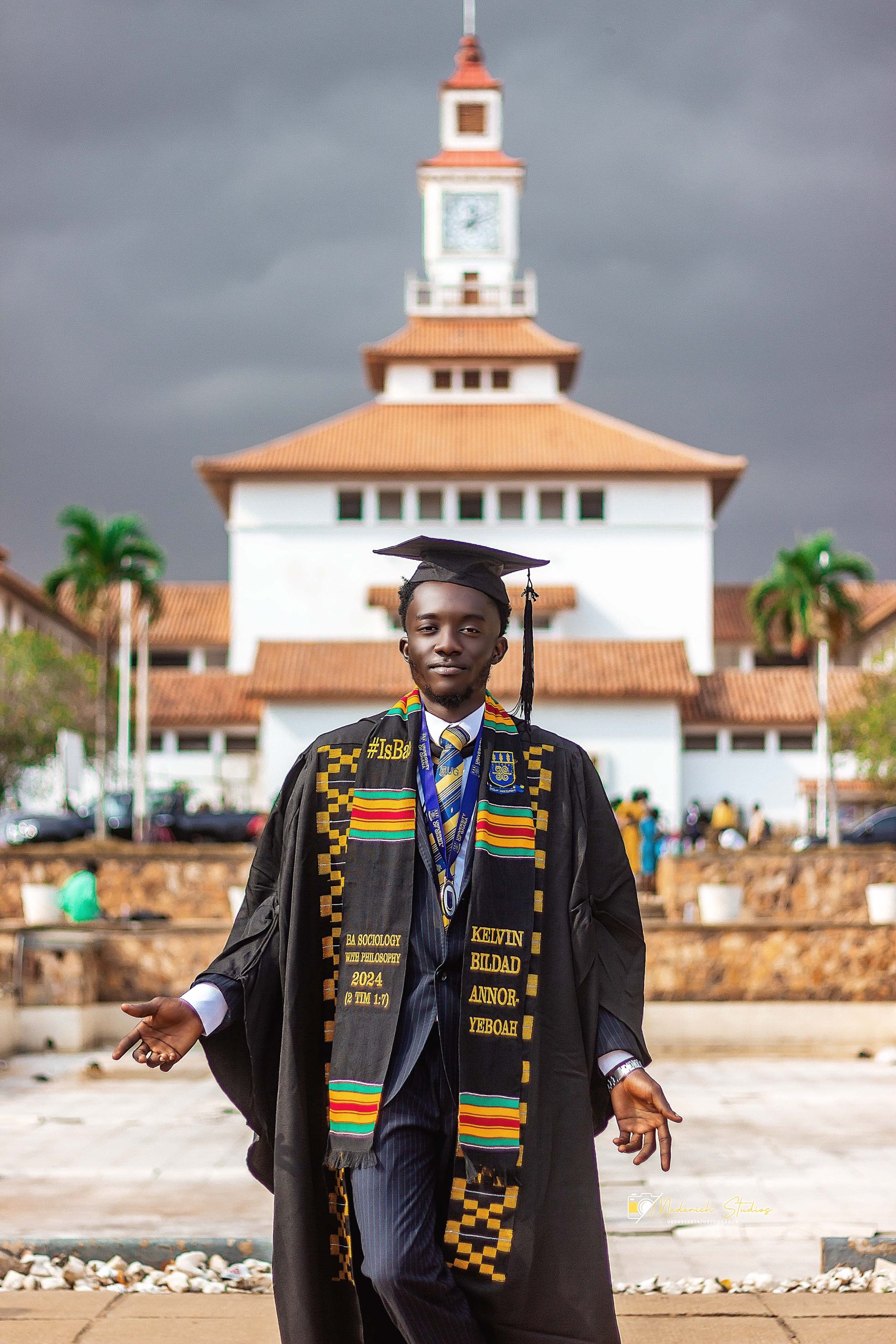
Just when I thought I was back on track, Level 200 hit me with a new challenge—I lost my residence. With no place to stay, I resorted to perching from room to room. That was when I miraculously met James Lutterodt, the brilliant 2021 KETASCO NSMQ contestant (of blessed memory), who offered me a place to stay. But even with that kindness, I found myself sleeping in the Commonwealth Hall library every night just to have a stable space to study.
The sacrifice paid off. That semester, my CGPA skyrocketed to 3.8.
Feeling accomplished, I let my guard down again. But as life would have it, another storm was on the horizon.
Gripped by Fear and Depression in Level 300
Level 300 was when I encountered what felt like a devastating emotional setback. It happened just before exams, and the weight of it overwhelmed me. I struggled to concentrate, and for the first time since my academic comeback, I got my first Cs. My CGPA dropped, though I was still within the First Class range.
Before this experience, I had always perceived depression as nothing more than a temporary mood swing, where people simply switch from happy to sad. But this was different. No one diagnosed me. I figured it out myself. It wasn’t just sadness; it was an overwhelming emptiness that clouded my mind and drained my energy. Anytime I tried to concentrate, I felt tears forcing their way out uncontrollably. It gripped me like sleep paralysis, and before I knew it, I had become insanely spiritual. You wouldn’t believe it if I told you I read the entire New Testament during this period, then moved on to the Old Testament. But when I got to Numbers, the boredom was unbearable, and I gave up there. I fasted, prayed, and did everything spiritual; things that, looking back now, make me laugh. At one point, I even visited a well-known pastor in Ghana, famous for miracles and prophecies, hoping that somehow, God would lead him to deliver me from this trauma. But nothing happened. That same day, I had an exam, yet I took the risk, travelled all the way to Ablekuma for the service, and still made it back in time to write the paper. Surprisingly, despite everything, I got an A.
What ultimately saved me was a friend who introduced me to 2 Timothy 1:7:
“For God has not given us a spirit of fear, but of power, and of love, and of a sound mind.”
I meditated on that scripture day and night until I finally overcame the darkness. But the damage had been done—my grades had taken a hit.
A Final Push in Level 400: The Unexpected Thesis
By Level 400, I was determined to finish strong. I worked tirelessly, confident that my academic standing would exempt me from writing a long essay. But just when I thought I was free, I was told I had to do it.
Initially, I was frustrated. I hadn’t prepared for a thesis, and the thought of the workload overwhelmed me. But then, two lecturers from my department reached out to personally convince me to take on the challenge. They had read my previous work and saw my potential as a writer.
That encouragement changed everything. I took on the project, and despite starting late, I was the first student in my batch to complete the thesis—and I earned an A! This 6-credit course boosted my FGPA, sealing my place in the First Class category.
Through this experience, I learned something profound: The best adventures happen when you face your fears. Writing that thesis not only strengthened my academic journey but ignited a love for writing that I carry with me today.
More Than Just Books: The Balance of Passion and Academics
What makes me even prouder of my First Class achievement is that I didn’t just study, I lived a full life. Throughout these four years, I:
- Volunteered at Radio Univers, where I eventually became the Head of the Entertainment Desk.
- Pursued my passion for music, releasing four professional songs with top-tier visuals.
- Balanced academics with journalism, music, and extracurricular commitments—all while striving for academic excellence.
- Self-taught beat production in Level 200 using YouTube tutorials, and today, I’m a pro producer, creating beats not just for myself but for other musicians as well.
- Earned some online academic certificates, further expanding my knowledge beyond the classroom.
Looking back, it wasn’t just about earning a First Class—it was about the discipline, sacrifices, and resilience it took to get there.
To sum it up, after all these struggles, imagine being told that the medal recognising your achievement would now be given to everyone. This is why I strongly believe excellence deserves distinction. My story is just one of many. But if there’s anything I’ve learned, it’s that true excellence is earned, not given freely.
The True Value of the Medal: Motivation and Institutional Pride
At its core, the First Class medal is not just about personal pride. It’s a tool for motivation and a reflection of the university’s commitment to excellence. For years, the promise of that medal has inspired students to put in extra effort, sacrifice leisure, and aim for the highest academic standards. I am one of those students.
By awarding medals to all classes, the university risks fostering complacency. Already, the mindset among students is shifting. Among the “boys boys,” you hear remarks like, “Why stress? We all get medals anyway.” What may sound like a joke reflects a deeper shift in attitude—one where academic excellence is no longer the primary motivation. Medals, once reserved for those who demonstrated exceptional effort and distinction, are now being reduced to mere tokens of participation. Introducing medals for all classes undermines this meritocracy. Students who would have otherwise strived for a First Class may now feel less motivated to push themselves, knowing that they will receive the same recognition regardless of their academic performance. This could result in a decline in the overall academic standards of the university, as the drive for excellence is weakened.
A prime example of this is the conversation I had with my coursemate a day after the graduation lists for the University of Ghana (2025) were released.
Image 1.
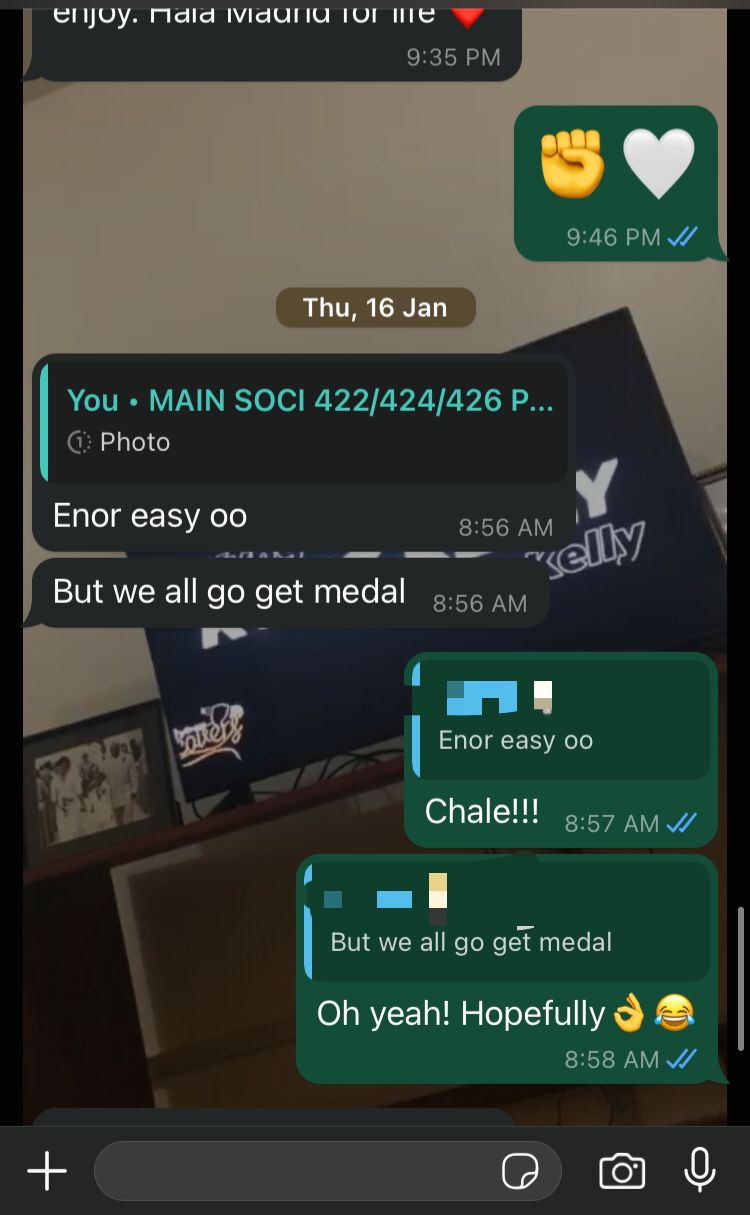
He assumed I had a class like his after I posted an image symbolising heartbreak with the caption “Atanfo enya me!”, a Ghanaian expression meaning “My enemies have gotten me!” As is often the case, misery loves company, so he slid into my DMs and wrote, “But we all go get the medal.” Hilarious, isn’t it?
Another example is the chat between me and my Senior High School mate, whom I met again at the University of Ghana, found below.
Image 2.

Similarly, a conversation with my Senior High School mate revealed another perspective. Meanwhile, a female friend expressed discontent about the policy, but only if she had been in the First Class range. Since she benefits under this new system, she seemed perfectly fine with it.
Balancing Financial Considerations with Academic Integrity
Consequently, this policy shift also raises financial concerns. Alongside the extension of medals, students have faced a steep increase in graduation fees from 400 cedis to 500 cedis, which is emanating from the introduction of Medals for all classes alongside a scroll. Not only has the graduation fee escalated, but also various fees, including medical fees, and the Residential Facility User Fees (RFUF). I will capture this moment to discuss some of the distressing fee increments that must be addressed.
According to Radio Univers (2024), the sharp increase in RFUF—from 1,500 cedis to 3,000 cedis, a 33.3% hike for continuing students, and a flat rate of 3,000 cedis for freshmen—has raised widespread concerns about affordability. However, under the leadership of SRC President Maradona Yeboah, popularly known as GURU, and his courageous and hardworking vice, a 25% reduction has been secured. Even more concerning is the introduction of a mandatory 500 Ghana cedis medical examination fee, with a steep 700 Ghana cedis late payment penalty tied to course registration. Future cohorts will be forced to comply with this policy, yet students can register for courses regardless of whether they undergo the examination. This raises serious questions about the policy’s true intent—if the medical examination were genuinely essential, why is course registration based on payment rather than completion of the test? Ultimately, the university must strike a balance between financial sustainability and its commitment to student welfare. Transparent communication and a well-justified rationale for such policies are essential for maintaining trust within the academic community.
Challenges with the New Medal Policy
One pressing question that arises from this new policy is how the university plans to distribute the medals during graduation. Traditionally, First Class graduates have been called to the stage to receive their medals as a form of public recognition. Under the new system, however, will all graduating students, regardless of their class, be similarly honoured on stage? If not, then a glaring issue emerges. It would be highly problematic and even humiliating for First Class students to receive their medals on stage, while students from other classes are left to collect theirs backstage. Such a setup would only serve to mock rather than honour the hard work of the non-First Class graduates, undermining the inclusive spirit the policy is meant to foster. It would be akin to receiving a prestigious BET nomination, winning the award, but then being handed it backstage, something which Nigerian artist Wizkid publicly opposed when he criticised the practice in a press conference (Bellanaija, 2017). Just as Wizkid’s protest highlighted the disrespect inherent in backstage recognition, a similar approach to awarding medals could diminish the prestige of the honour for those not receiving it on stage, raising serious questions about the true intent behind the policy. Moreover, awarding medals to every student could significantly lengthen graduation ceremonies, leading to a tedious and frustrating experience for students and their families.
Counterargument 1: “You’re Only Arguing This Because You’re a First-Class Student”
Having outlined my position on this matter, it’s important to now address the counterarguments that are likely to arise from those who disagree with me. This section will tackle those opposing views head-on.
First of all, it is true that as a First Class student, I have personally experienced the effort, discipline, and dedication required to earn that distinction. But that does not invalidate my argument—it strengthens it. One common rebuttal to this stance is the assumption that only First Class students oppose the policy of awarding medals to all graduates, perhaps because they want to maintain an air of superiority. However, this argument disregards the true nature of what it takes to earn a First Class distinction.
First Class students often prioritise their academics above all else, sacrificing social engagements, relationships, and leisure activities to secure their grades. This suggests that life as a First Class student is often characterised by discipline, rigorous study schedules, and, for many, a relatively uneventful social life. In fact, rather than seeking to boast about their achievements, many First Class students might argue that the honour should be preserved precisely because of the immense sacrifices required to attain it.
This perspective moves beyond personal bias and focuses on maintaining the integrity of academic recognition. The issue at hand is not about First Class students trying to hoard prestige but about ensuring that medals remain a symbol of outstanding academic performance, much like how elite athletes earn gold medals through dedication and sacrifice. It is for this reason that I often tell my colleagues that even if I hadn’t earned a First Class, I would still advocate for this position, because the core of my argument lies in upholding these principles. By equalising their recognition with others who did not achieve the same level of excellence and distinction, the university sends a message that extraordinary effort is not worth striving for.
Medals symbolise countless hours of hard work, sacrifice, and commitment. This is not about “excluding” others but about preserving the integrity of that recognition. If it is overlooked by awarding all classes with medals, it blurs the lines between exceptional and average performance. While it’s commendable to recognise everyone’s journey, it is equally important to celebrate and elevate those who have reached the pinnacle of academic success.
Counterargument 2: “The Medal is Just a Trinket; the Certificate is What Matters”
Additionally, some argue that the medal is inconsequential because it is not used during job searches or career advancement; what employers value most is the certificate and the degree classification. However, this argument contradicts the very push for “medals for all classes.” If the medal truly didn’t matter, why are some students now clamouring to receive it?
The answer is simple: the medal matters because of the prestige it carries. Wearing the First Class medal at graduation is not about utility but about recognition and honour. It is a visible, symbolic representation of one’s hard work and academic excellence. It signifies that the wearer has gone above and beyond to achieve the highest academic distinction.
When you see students striving for medals across all classes, it’s proof that the medal carries a sense of pride. If it were meaningless, there would be no push for this policy. By awarding medals to all classes, the university dilutes this prestige and renders the medal insignificant, erasing its symbolic power.
Counterargument 3: “A Distinction Has Already Been Made for First Class Medals”
The distinction of a First Class honour relies not just on the recognition itself but on the exclusivity it represents. Academic achievements that are not universally attainable carry greater significance when they are reserved for a select few. When the First Class medal is awarded to all graduating students, regardless of their classification, it diminishes the unique recognition for those who have truly excelled.
The value of this distinction lies in its rarity, as mentioned earlier, signifying an extraordinary accomplishment in a competitive environment. If everyone receives the same level of recognition, it undermines the concept of exceptional academic achievement. This shift risks turning the First Class medal into a generalised token of participation, rather than a true mark of distinction, making it lose its value as a symbol of the highest academic standards. Just as in other areas of life, such as awards and honours, exclusivity amplifies the prestige of the recognition and helps maintain its relevance as a genuine acknowledgement of excellence.
Institutional Reputation at Stake
Furthermore, the University of Ghana has built its reputation as a premier academic institution by setting high standards for its students. Over the years, the University of Ghana has been eyed by other institutions in Ghana and even Africa for their Medal for “First Class students Only”. By awarding medals to all classes, the university dilutes this brand. Employers and stakeholders may begin to question the calibre of graduates if the distinction between excellence and average performance is no longer clear.
A Balanced Approach: Recognising All While Celebrating Excellence
To suggest a few points to mitigate this problem, the university can—and should—recognise the efforts of all graduates. However, this recognition must not come at the expense of academic excellence. Here’s how this balance can be achieved:
- Medals Reserved for Excellence: First Class medals should remain exclusive to those graduates who achieve exceptional academic success, preserving the prestige and significance of the award. This exclusivity not only honours the hard work of these students but also sets a clear benchmark for future students to aspire to. Moreover, restricting medals to First Class graduates helps to manage graduation-related costs, sparing high-achieving students from additional financial strain, especially when they already rightfully deserve recognition. Allowing others to share in this award would dilute its value, placing an unnecessary burden on the system and undermining the incentive for academic excellence.
- Non-Medal Awards for Other Classes: To maintain inclusivity without diminishing the significance of the First Class medal, the university could introduce alternative forms of recognition, such as pins, ribbons, or certificates, for graduates from other classes. These would serve as meaningful acknowledgements of their achievements without undermining the exclusivity of the First Class honour. For example, awarding Scrolls in Place of Medals. As a more balanced approach, the university could award all graduates, regardless of class, with graduation accoutrements like the scroll but reserve the medals solely for First Class students. This would ensure that every graduate is recognised for their achievement while maintaining the prestige and distinction of the First Class medal.
Excellence Deserves to Shine

In conclusion, it is an illusion that is cherished that the “Medal for All Classes” policy is meant to foresee inclusivity and honour the journey and hardwork of all graduates, because while well-meaning, it threatens to erode the principles of meritocracy, excellence, and motivation that the University of Ghana has long upheld. The medal matters because of the prestige it symbolises and the motivation it inspires. A medal isn’t just an object, it’s a symbol of the journey, the long nights, the heartbreaks, and the resilience required to excel. Not all journeys are the same, and not all achievements should be treated as equal. Inclusion is important, but it must not come at the cost of excellence. The ‘Medal for All Classes’ policy risks diluting the symbolic value of academic achievement. Let us celebrate every graduate’s journey, but let us also preserve the honour of those who strive for and achieve exceptional success. Excellence deserves to shine—uncompromised and undiluted. The shift towards broader inclusion in medal awards, while commendable for fostering a more inclusive environment, should be approached with careful consideration of the academic standards that have long defined the university. The university’s legacy of excellence is something that many of us hold dear. If we reward mediocrity, we risk losing the very motivation that drives students to strive for greatness. Let excellence shine; uncompromised and undiluted.
Reference:
Kezele, S. (2024, July 26). Paris Olympic medalists take home actual piece of Eiffel Tower. NBC Olympics. Retrieved from https://www.nbcolympics.com/news/paris-olympic-medalists-take-home-actual-piece-eiffel-tower#:~:text=An%20original%20piece%20of%20the,Radiance
Bellanaija. (2017, December 7). Wizkid blasts organisers of African awards. BellaNaija. https://www.bellanaija.com/2017/12/wizkid-blasts-organizers-african-awards/
Radio Univers. (2024, February 1). UG revises traditional hall fees for 2024/2025 academic year. Univers News. https://univers.ug.edu.gh/ug-revises-traditional-hall-fees-for-2024-2025-academic-year/
Story by: Kelvin B. Annor-Yeboah | univers.ug.edu.gh



Really appreciate how you make everyone 🌟 feel included and welcome in this space
Superb insights here
This content feels like breath of fresh air in chaotic world
Hello there, simply become aware of your blog via Google, and found that it’s really informative. I’m going to be careful for brussels. I’ll appreciate when you proceed this in future. A lot of other people will be benefited out of your writing. Cheers!
I just could not leave your web site before suggesting that I actually enjoyed the standard information an individual provide on your visitors? Is gonna be again steadily in order to check out new posts
What i do not realize is actually how you are not really a lot more well-favored than you may be right now. You are very intelligent. You recognize thus considerably in the case of this subject, produced me for my part imagine it from numerous numerous angles. Its like men and women don’t seem to be fascinated until it is something to do with Woman gaga! Your own stuffs excellent. All the time take care of it up!
The very crux of your writing while appearing agreeable in the beginning, did not settle properly with me personally after some time. Someplace within the paragraphs you managed to make me a believer unfortunately just for a while. I nevertheless have a problem with your jumps in logic and you would do well to fill in those breaks. In the event that you actually can accomplish that, I could certainly be impressed.
I dugg some of you post as I cogitated they were very beneficial very helpful
You completed certain nice points there. I did a search on the subject and found nearly all people will agree with your blog.
There is perceptibly a bundle to identify about this. I feel you made certain nice points in features also.
I appreciate, cause I found exactly what I was looking for. You have ended my four day long hunt! God Bless you man. Have a great day. Bye
Can I just say what a relief to find someone who actually knows what theyre talking about on the internet. You definitely know how to bring an issue to light and make it important. More people need to read this and understand this side of the story. I cant believe youre not more popular because you definitely have the gift.
Some genuinely fantastic content on this internet site, thankyou for contribution.
I’m still learning from you, but I’m making my way to the top as well. I certainly liked reading all that is written on your website.Keep the stories coming. I enjoyed it!
Very efficiently written post. It will be useful to anybody who utilizes it, including yours truly :). Keep doing what you are doing – for sure i will check out more posts.
I?¦m now not positive the place you’re getting your information, but great topic. I must spend a while studying much more or working out more. Thanks for excellent info I was looking for this info for my mission.
Hiya very nice web site!! Guy .. Excellent .. Amazing .. I will bookmark your website and take the feeds also…I am happy to find a lot of useful info here in the publish, we need work out more techniques on this regard, thanks for sharing. . . . . .
I as well believe so , perfectly composed post! .
Hello! I’ve been reading your website for a while now and finally got the courage to go ahead and give you a shout out from Houston Texas! Just wanted to say keep up the good work!
Generally I do not read article on blogs, but I would like to say that this write-up very forced me to try and do so! Your writing style has been amazed me. Thanks, very nice post.
Today, I went to the beach with my children. I found a sea shell and gave it to my 4 year old daughter and said “You can hear the ocean if you put this to your ear.” She put the shell to her ear and screamed. There was a hermit crab inside and it pinched her ear. She never wants to go back! LoL I know this is totally off topic but I had to tell someone!
Heya i’m for the primary time here. I came across this board and I in finding It really useful & it helped me out a lot. I am hoping to present something again and help others such as you aided me.
Hey would you mind sharing which blog platform you’re working with? I’m going to start my own blog soon but I’m having a difficult time making a decision between BlogEngine/Wordpress/B2evolution and Drupal. The reason I ask is because your layout seems different then most blogs and I’m looking for something completely unique. P.S Sorry for getting off-topic but I had to ask!
Have you ever thought about creating an e-book or guest authoring on other sites? I have a blog centered on the same subjects you discuss and would love to have you share some stories/information. I know my visitors would value your work. If you are even remotely interested, feel free to send me an e mail.
This blog is definitely rather handy since I’m at the moment creating an internet floral website – although I am only starting out therefore it’s really fairly small, nothing like this site. Can link to a few of the posts here as they are quite. Thanks much. Zoey Olsen
Thanks a bunch for sharing this with all folks you actually know what you are speaking approximately! Bookmarked. Kindly also seek advice from my web site =). We may have a link exchange contract among us!
Hello my family member! I want to say that this article is awesome, great written and include approximately all vital infos. I?¦d like to peer extra posts like this .
Its like you read my mind! You appear to know a lot about this, like you wrote the book in it or something. I think that you can do with some pics to drive the message home a little bit, but other than that, this is fantastic blog. An excellent read. I will certainly be back.
I’ve been absent for some time, but now I remember why I used to love this blog. Thanks, I will try and check back more frequently. How frequently you update your web site?
Wow! Thank you! I continually needed to write on my site something like that. Can I include a fragment of your post to my website?
I like what you guys are up also. Such clever work and reporting! Keep up the excellent works guys I?¦ve incorporated you guys to my blogroll. I think it’ll improve the value of my web site 🙂
Don’t let one failure stop your entire journey.
Hi! This is my first comment here so I just wanted to give a quick shout out and say I truly enjoy reading your blog posts. Can you recommend any other blogs/websites/forums that go over the same topics? Thanks a lot!
References:
Casino el camino https://topsitenet.com/profile/walkmemory99/1871586/