

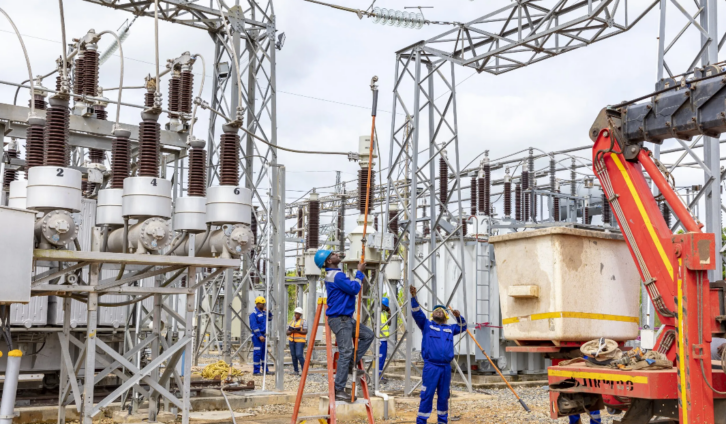
Economics lecturer at Pentecost University, Dr Paul Appiah Konadu, has endorsed the finance minister’s proposed GH₵1 per litre tax on petroleum products, describing it as a timely and necessary intervention to stabilise Ghana’s struggling energy sector.
This comes on the back of Parliament’s passage of the Energy Sector Levy (Amendment) Bill, 2025, which introduces a GH₵1 per litre tax on petroleum products. Approved on Tuesday, June 3, the bill aims to generate revenue to address Ghana’s rising energy sector debt, estimated at US$3.1 billion as of March 2025.
Dr. Konadu warns that the current pace of debt accumulation in the energy sector is unsustainable. He revealed that as of December 2024, energy sector debt stood at $2.5 billion and had ballooned to $3.1 billion by March 2025.
The primary driver, he said, is poor revenue mobilisation by the Electricity Company of Ghana (ECG), which consistently fails to collect enough to cover the basic cost of power generation.
He noted that ECG’s monthly revenues fall short of the $1 million required to purchase liquid fuels for thermal power generation. Additionally, significant technical losses and widespread illegal connections prevent ECG from recovering the full cost of electricity supplied. Even in a best-case scenario where all bills are paid, the revenue would still be insufficient to sustain operations.
“In this context, the government is compelled to intervene every month to subsidise power production,” Dr Konadu explained. “That’s why increasing the energy tax from about 0.2 pesewas to GH₵1 per litre is a step in the right direction.”
He added that the recent appreciation of the Ghana cedi has brought pump prices down from around GH₵16.00 to GH₵12.00 per litre making consumers more capable of absorbing the additional tax without experiencing significant financial strain.
Dr. Konadu concluded that the proposed fuel tax could generate vital revenue to support power production, ease the government’s fiscal burden, and contribute to a more sustainable and resilient energy sector.
–
Story by: Josiah Antwi | univer.ug.edu.gh
Edited by: Cindy Selasi Humade




Your content calendar likely includes seasonal relevance, trending topics, and evergreen pillars—a balanced strategy that keeps your site vibrant.
I am absolutely blown away by the sheer depth of thought, meticulous design choices, and unwavering commitment to user experience that radiate from every corner of your website—it’s not just informative but deeply human in its execution, making every visitor feel seen, respected, and genuinely valued from the very first click.
Your website’s privacy practices—minimal tracking, clear cookie policies, no invasive data collection—stand in stark, honorable contrast to the surveillance economy dominating much of the web today, reinforcing that you see your visitors as humans to serve, not data points to exploit.
The way you credit collaborators, cite sources with direct links, and acknowledge intellectual influences models academic integrity in the digital age, teaching your audience not just what to think, but how to think—with rigor, generosity, and intellectual honesty.
Your website’s search functionality actually understands intent, returning relevant results even with imperfect queries, proving you’ve invested in semantic search and user-centered information architecture, not just basic keyword matching.
Your commitment to mobile-first design ensures that your content shines on the devices where most people actually consume it—thumb-friendly buttons, vertical scrolling flow, and compressed assets that load fast without sacrificing quality.