
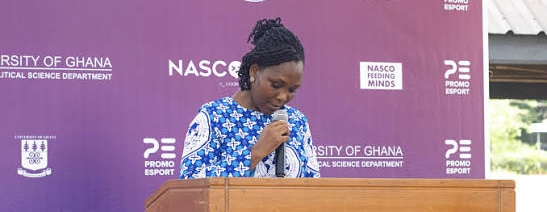
Senior Lecturer at the Department of Political Science, University of Ghana, Dr Rosina Foli, has stated that establishing appropriate dispute resolution mechanisms and enhancing civic education among the populace are key to fostering peaceful political transitions in Ghana.
She made the remarks at the Ghana Academy of Arts and Sciences’ 2025 Founders’ Week celebrations in Accra, held from November 11 to 14.
Speaking as a guest on Day Three of the event, Dr Foli revealed that the existence of key legal reforms and the strict enforcement of laws for all stakeholders in both the civic and political spaces are necessary preconditions for effectively managing transition periods between election cycles.
“Key legal reforms and clear dispute resolution mechanisms must be fully embedded within the country’s democratic architecture to engender peace and trust among all stakeholders. These are the essential ingredients for successful political transitions in our longstanding Fourth Republican dispensation, which must be built on an inclusive democracy rather than the much-derided ‘winner-takes-all’ system currently in place,” she said.
Dr Foli added that during tense electoral periods, it is incumbent on state institutions to establish internal monitoring and evaluation platforms to identify high-risk areas capable of disrupting national peace, in order to guarantee the safety of all actors.
“Beyond sustained citizen engagement and bipartisan collaboration needed to fuel the growth of electoral democracy in Ghana, relevant state agencies — from law enforcement to civic actors — must deploy internal monitoring and evaluation mechanisms that detect early warning signals and inform adequate preparation, both policy-wise and logistically, to forestall unforeseen occurrences that may threaten national peace and tranquillity during election cycles,” she noted.
The Chairman for the event, Professor Alfred Oteng Yeboah, also noted that Ghana’s democratic journey, particularly under the Fourth Republic, has stood the test of time. He emphasised that continued dialogue and the strengthening of independent institutions that promote national development must be supported by all citizens to meet the country’s collective aspirations.
“The brilliant submissions from the speaker, Dr Foli, point to one sacred fact: democracy remains the key foundation for any nation’s full development and the realisation of the aspirations of its people. Though the journey may not always be smooth on a turbulent continent, democracy must remain the bedrock of our collective progress, and the evidence shows that we are on the right path toward the growth we seek for our people,” he said.
The event brought together Fellows of the Academy, members of the public, selected journalists, and students from Accra Academy and Presbyterian Boys’ Secondary School, Legon.
The theme for the Week celebrations was: “Navigating Political Transitions in Ghana: Issues and Lessons.”
–
Story by Sika Togoh | univers.ug.edu.gh
Edited by Gabriel Tecco Mensah