

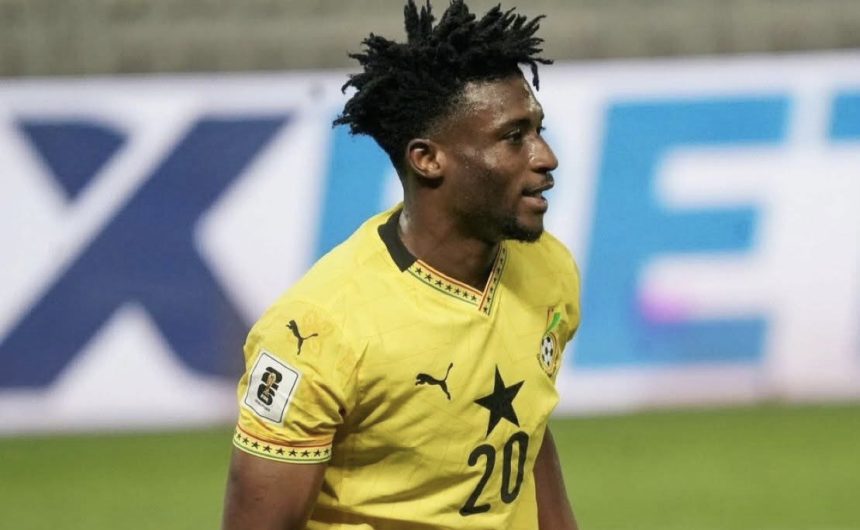
Ghana’s preparations for the 2026 FIFA World Cup have suffered a significant setback following the omission of three key players—Mohammed Kudus, Alexander Djiku, and Mohammed Salisu—from the Black Stars’ final squad due to injury.
The trio have been among Ghana’s most influential performers in recent years, and their absence comes at a crucial moment as the Black Stars prepare for a difficult Group L campaign against England, Croatia, and Panama.
The headline absentee is Mohammed Kudus, whose injury has ruled him out of the tournament after months on the sidelines.
The Tottenham Hotspur attacker has not played since January after suffering a quadriceps injury and subsequently experiencing a setback in his recovery.
Despite hopes that he could return in time for the World Cup, he failed to regain full fitness and was ultimately left out of Carlos Queiroz’s squad.
Kudus’ absence is arguably the biggest blow to Ghana’s World Cup ambitions. Since emerging as the face of the national team, the 25-year-old has consistently delivered moments of brilliance in Black Stars colours, scoring 13 goals in 46 appearances since his senior international debut in November 2019 and often carrying the team’s creative burden in major matches.
His ability to dribble past opponents, create chances, score from distance, and influence games in tight spaces makes him one of Ghana’s most unique talents.
Without him, much of the attacking responsibility is expected to fall on Antoine Semenyo, Inaki Williams, Kamaldeen Sulemana, and Abdul Fatawu Issahaku.
Equally concerning is the absence of defender Mohammed Salisu. The commanding centre-back has been ruled out with a serious anterior cruciate ligament (ACL) injury in his left knee, depriving Ghana of one of its most reliable defensive leaders. Salisu’s strength in aerial duels, composure on the ball, and experience at the highest level made him a near-certain starter whenever fit.
His partnership with Alexander Djiku had become one of the foundations of Ghana’s defence in recent years. However, Djiku has also been forced to withdraw from the squad through injury, with reports indicating that he has been replaced by Derrick Luckassen.
The absence of both Salisu and Djiku leaves Ghana without two of their most experienced defenders heading into a tournament where they will face world-class attacking talent from England and Croatia. Their leadership, organisation, and understanding at the back will be difficult to replace.
While Ghana still possess quality throughout the squad, the injuries have significantly altered Carlos Queiroz’s plans.
The Portuguese coach will now have to rely on alternative defensive options, including Jonas Adjetey, Jerome Opoku, Derrick Luckassen, Kojo Oppong Preprah, and the recalled Baba Rahman to provide stability.
The positive news for Ghana is that several key players remain available. Captain Jordan Ayew, Thomas Partey, Inaki Williams, Kamaldeen Sulemana, Abdul Fatawu Issahaku, Antoine Semenyo, and Ernest Nuamah are all expected to play central roles in the team’s World Cup campaign.
Ernest Nuamah’s return after recovering from a long-term injury provides an additional attacking option at a time when the squad is short on creativity.
However, there is little doubt that the absence of Kudus, Salisu, and Djiku will force Ghana to adapt both tactically and mentally.
Kudus offered unpredictability and match-winning quality in attack, while Salisu and Djiku brought experience and authority to the heart of defence.
For a team hoping to make a deep run at the World Cup, losing three established starters before the tournament begins is far from ideal.
Yet if Ghana are to progress from a challenging group, the Black Stars will need others to step forward and prove that the team is stronger than the individuals it has lost.
The World Cup begins from June 11, to July 19, 2026, and while Ghana’s squad has been weakened by injury, Carlos Queiroz and his players will hope that resilience, depth, and collective effort can compensate for the absence of three of the country’s biggest stars.
–
Story by Erica Odeenyin Odoom | univers.ug.edu.gh