
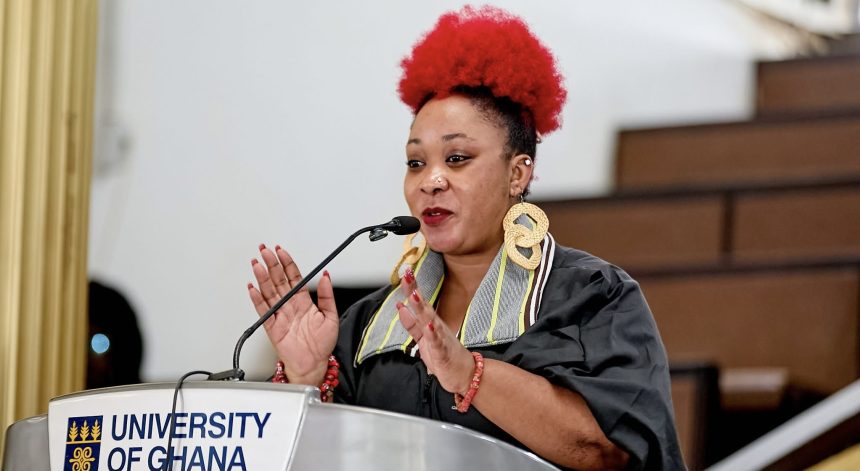
Guest speaker at the first session of Day Two of the University of Ghana’s February 2026 Congregation, acclaimed poet, writer, and media practitioner Seyiram Apiorkor, has delivered a provocative charge to the graduating class of the College of Humanities.
Speaking at the Great Hall on February 11, 2026, Apiorkor—who is recognized for her expertise in Cultural Diplomacy, Marketing, and International Relations—eschewed the traditional congratulatory tone.
She told the new graduates that their degrees are not trophies of comfort, but heavy burdens of responsibility.
“I’m not handing your education back to you as an achievement, because it is not an achievement. I’m handing it back to you because it is a burden. It’s not meant to bring you comfort. Comfort is only a byproduct of a good education.”
Apiorkor emphasized that the privilege of a university education “implicates” the holder. She argued that the true value of a degree lies in how it “weighs down” the individual, compelling them to push for a better society rather than using their status to escape national problems.
She urged the graduates to carry their education into “the rooms where decisions are made” on behalf of those who will never have the opportunity to step foot in the Great Hall.
Addressing the current state of the nation, Apiorkor identified a critical flaw in the country’s leadership and professional class. She noted that Ghana does not lack intelligence, but rather the courage to stand by one’s principles.
“Ghana does not suffer from a lack of intelligence or intelligent people. It suffers from a lack of ethical stubbornness — people who know better but still choose the easier route; people who understand systems but excuse them repeatedly.”
In a direct appeal to the youth, many of whom are considering leaving the country in search of better opportunities, Apiorkor stated that the “dividing line” for the next generation is not their physical location, but their emotional presence.
“Some of you will leave Ghana, and some of you will stay. But that’s not the dividing line,” she said. “The dividing line is this: ‘Will you use your education to distance yourself from a problem that you see, or will you stand closer to it?’”
She concluded by warning the graduates against becoming “emotionally absent” from their surroundings. She challenged them to reject the transactional nature of modern culture and instead lean into the “itch of questions” that a truly transformative education provides.
—
Story by Wilhemina Dushie | univers.ug.edu.gh
Edited by Gabriel Tecco Mensah