

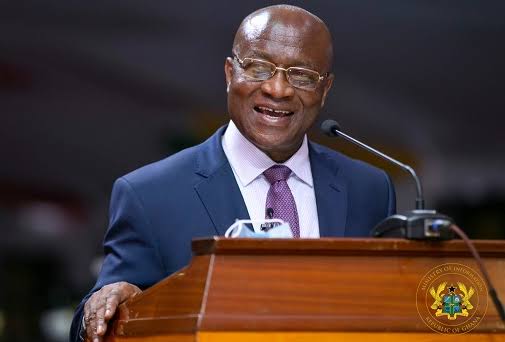
Former Majority Leader, Osei Kyei Mensah Bonsu, has stated that the rationale behind the Presidential Transition Act is to create an effective framework that ensures the seamless transfer of power between administrations, thereby strengthening Ghana’s democracy.
He made this remark at the Ghana Academy of Arts and Sciences’ 2025 Founders’ Week celebration, held under the theme: “Navigating Political Transitions in Ghana: Issues and Lessons.”
According to him, the Act was a bipartisan and national effort aimed at establishing an efficient political transition mechanism that facilitates smooth transfers of power between successive governments and reduces the acrimony that often characterises such processes, drawing lessons from established democracies.
“As a key step in strengthening the burgeoning democracy of a country like Ghana, the practice of the 2012 Transitions Act, which has been applied across various political turnovers, can be juxtaposed with those in countries such as the USA, South Africa and Kenya, whose jurisdictions have well-established mechanisms to manage such transitions with little to no fuss. This also gives us room to fine-tune our processes to meet world-class standards across the continent and beyond,” he said.
Osei Kyei Mensah Bonsu further noted that although Ghana is globally recognised as a peaceful democratic nation, certain actions during past political transitions — particularly between 2000 and 2009 — necessitated the promulgation of the Act to establish clear mechanisms for consolidating state power and ensuring effective governance during transition periods.
“Even though Ghana has been on the global map as a consistent and model oasis of peace in a relatively volatile sub-region and continent, not everything about our cross-party political transitions has been ultra-smooth. The tensions and mistrust that characterised previous power turnovers, especially in 2000 and 2008, prove that there are still chinks in our democratic fibre,” he said. “Allegations of misclassification of state assets, lack of detailed handover notes and other related matters somewhat disorganised the political climate during those periods under review.”
The Chairperson for the session, Emerita Professor Takyiwaa Manuh, called for a further review of the Act in its current form in relation to present realities and urged stakeholders to use hindsight to refine it in line with the evolving political climate.
“It is instructive to note that, as the eminent Speaker intimated, the Act has done the nation a great deal of good by reducing the intermittent political skirmishes witnessed in the past. However, like all documents, societies evolve and our laws must align with contemporary trends that uphold the best values of democracy. Political power must be exercised for the overall advancement of our nation, and any legal instrument that streamlines the management of such powers is vital to our democratic process in a largely volatile region,” she stated.
The well-attended event drew participation from Fellows of the Academy, senior academics, policymakers, selected journalists and students from senior secondary schools in Accra.
—
Story by Sika Togoh | univers.ug.edu.gh
Edited by Gabriel Tecco Mensah