
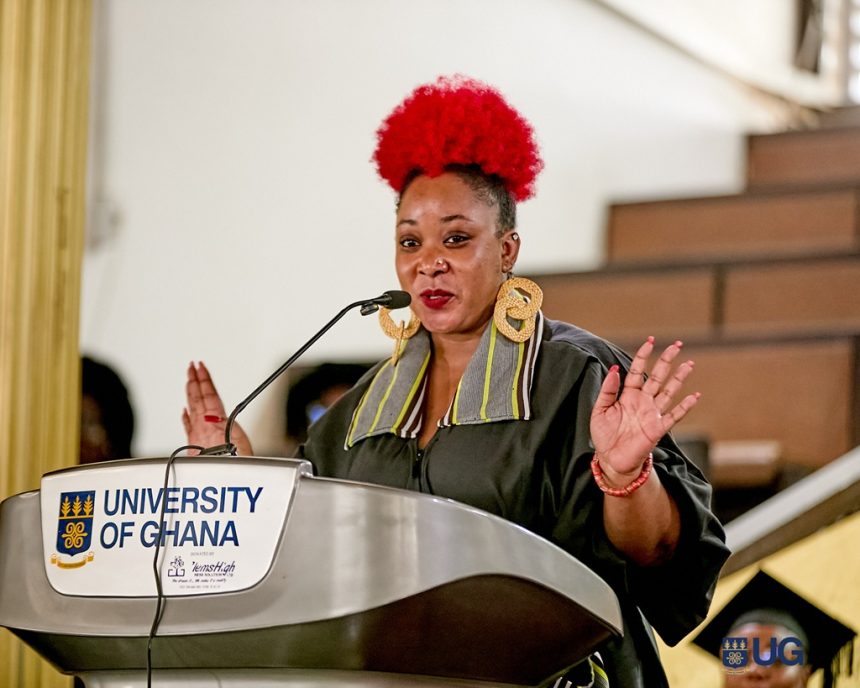
Acclaimed poet, writer, and media practitioner Seyiram Apiorkor has challenged graduates of the University of Ghana to allow their education to unsettle them deeply enough to inspire meaningful change in society.
Delivering the guest address at the first session of Day Two of the University’s February 2026 Congregation, Apiorkor offered a speech that moved beyond celebration and into reflection. While acknowledging the significance of the milestone, she urged graduates to interrogate the true impact of their academic journey.
Declaring that she prefers to speak about uncomfortable things, Apiorkor signaled early on that her remarks would depart from the usual congratulatory tone of graduation ceremonies.
“I like to speak about uncomfortable things. Now you’re here to receive your degrees today. I’d like you to know that the education that you are being awarded the degree for—you need to ask yourself a certain question,” she said.
She cautioned the graduates against treating their degrees as mere certificates of completion, stressing that true education must leave a visible mark on one’s thinking and worldview.
According to her, transformation is the true measure of learning — not grades, accolades, or applause.
“Now I’m asking because if nothing has been disrupted, then it means that nothing has been transformed. And that should worry you because the University of Ghana has given you a transformative education.”
Apiorkor explained that if the University’s education has truly done its work, graduates should feel a sense of unease about the state of the world around them.
“If your education is transformative and the experience that you’ve had here at the University of Ghana has done the work that it should have done, then you should feel slightly unsafe with how things around you, in your community, in your society, in the country, in the world are at the moment,” she said.
She further encouraged them to embrace the restlessness that comes with awareness.
“You should feel the weight of knowing that you can no longer pretend that now that you are educated, you have been exposed, you are enlightened, you see certain things. You see what is wrong. You see what could be better. You see what your society is failing at. You see where young Ghanaians like yourself, citizens of the world like yourselves, are being shortchanged. And then how can you be an agent of change?”
For Apiorkor, education is not merely a ladder to personal success. It is a lens through which injustice becomes clearer and a tool through which solutions can be imagined. With that clarity comes responsibility — the obligation to contribute meaningfully to shaping a better society.
She concluded by challenging graduates to move beyond observation and become active participants in change.
Rather than simply identifying what is wrong, she encouraged them to ask how they could become part of the answer.
–
Story by Erica Odeenyin Odoom | univers.ug.edu.gh