

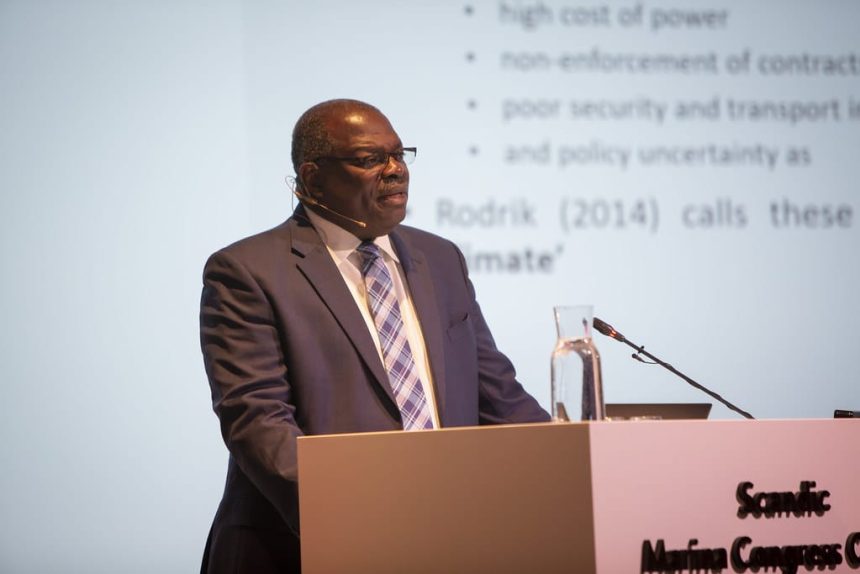
Economist and former Vice-Chancellor of the University of Ghana, Emeritus Professor Ernest Aryeetey, has called for a fundamental transformation in how social science research and teaching are conducted across Africa, arguing that current approaches no longer reflect the continent’s rapidly evolving societies.
Speaking at the 9th School of Social Sciences Conference held at the University of Ghana on Wednesday, March 11, 2026, he highlighted what he described as the “paradox of a changing Africa”—a phenomenon where societies are transforming quickly while economic structures remain largely stagnant.
Prof. Aryeetey said Africa’s economies have experienced little structural transformation over the past several decades, despite significant social changes driven by technology, migration, and globalization.
“Even though Africa has not changed much structurally for the last seven decades, the people are changing and the society is changing. So how do you live in a country where the people are changing but the economy is not changing?” he questioned.
He explained that this paradox should compel social scientists to rethink the theories they teach and the type of research they pursue.
“The theorists we teach were made for a particular type of Africa, but the Africa we have today was not foreseen by many of those social theorists,” he noted.
Prof. Aryeetey also pointed to technological advancement and globalization as key drivers of lifestyle transformations across the continent, even in rural communities.
“Today you can live in a rural part of the country and still have an urban life. Young people in villages follow global events, watch international football, and use digital services in ways that were impossible years ago,” he added.
He further warned that Africa’s growing inequalities could worsen if economic systems fail to adapt to these societal changes.
“Those who can send their children abroad for education are giving them advantages others will not have, and the gap between the haves and the have-nots will continue to widen,” he cautioned.
To address these challenges, Prof. Aryeetey urged social scientists to adopt more interdisciplinary research approaches and leverage technology to tackle Africa’s development problems.
“The challenges we face today cannot be solved by one discipline alone. Economists, sociologists, political scientists, and others must work together to find solutions.”
He also stressed the importance of engaging with governance and policy processes to ensure that research contributes to meaningful societal transformation.
“If we want to change the systems that determine production, education, and justice, we cannot ignore politics,” he emphasized.
The conference brought together academics, researchers, and students to discuss the role of social sciences in addressing emerging challenges across the African continent.
–
Story by Benedicta Asante | univers.ug.edu.gh
Edited by Erica Odeenyin Odoom