

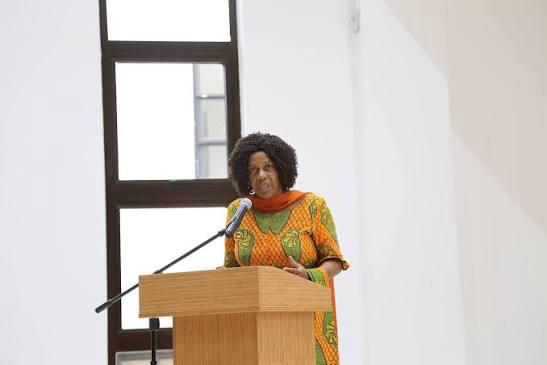
Renowned scholar in gender and development economics,Prof. Abena Oduro has highlighted the need to factor care work into Ghana’s Gross Domestic Product (GDP).
Delivering the second keynote address on Day Two of the African Review of Economics and Finance (AREF) Conference on November 20, 2025, Prof. Oduro emphasized the redefinition and inclusion of care work in GDP calculations.
She explained that recognising paycare work is essential to acknowledging the economic value of women’s contributions.
“ I recommend that we should include unpaid care work in the definition of the Gross Domestic Product. The importance of unpaid work in the home has been recognized at the continental level. Article 30H of the Protocol to the African Charter on Peoples’ and Human Rights on the Rights of African Women, otherwise known as the Maputo Protocol, expects that the state parties will, and I quote, take the necessary measures to recognize the economic value of the work of women in the home. One important first step to achieving this is to redefine and include and pay attention to domestic work in the estimation of GDP.”
Prof. Oduro further stated that increased investment in care infrastructure is necessary and would enhance efficiency and reduce the time burden on women,enabling greater economic participation.
“Second, I recommend that there should be an increase in investment in care infrastructure. Recognition of the value of unpaid care and domestic work to the market economy implies that investments in care infrastructure that will improve efficiency and reduce time costs are required. Macroeconomic models have been developed to show that an increase in public sector spending on social services reduces the burden of care of women and improves labour productivity.”
Professor Oduro then went ahead to explain that GDP often ignores and leave out the overall wellbeing of the people and hence called on Africans to develop a dashboard of indicators to monitor human wellbeing taking into consideration inequalities that’s actually reflects the well being of the citizens .
“My fourth recommendation is that we develop a dashboard of indicators that will be tracked to monitor human well-being. I’ve got a number of alternatives, but I will not look at them, I will look at what I want to recommend. This is, as I’ve said, to employ a dashboard to track non-monitoring indicators separately.Now, an example of this is the Sustainable Development Goals. But Africa has its vision of what its future should have provided a framework from which we can derive or develop indicators of progress. The indicators should capture inequality and should capture non-market activities.”
She explained that this new framework would include both outcome indicators and input indicators to provide a true reflection of citizen wellbeing, going beyond mere economic output.
_
Story by Kwadwo Owusu Anane| univers.ug.edu.gh
Edited by Deborah Owusu