
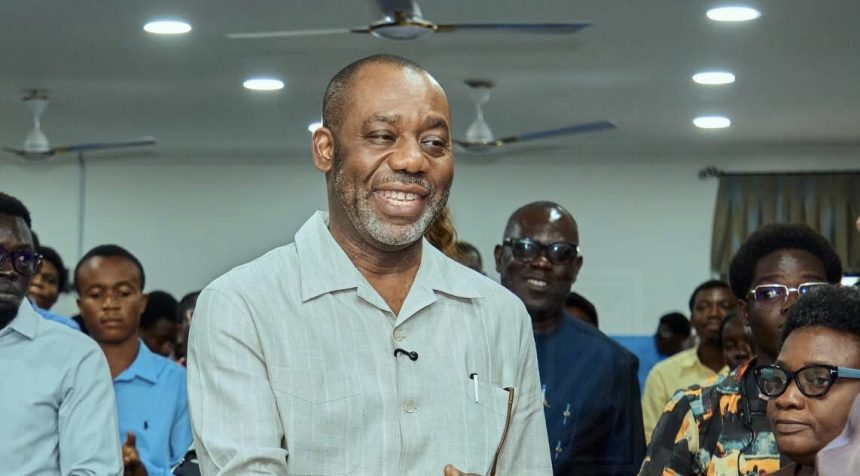
Former Minister of Education and former Member of Parliament for Manhyia South, Dr. Matthew Opoku Prempeh, popularly known as NAPO, has cautioned against the dangers of political misinformation and deliberate misinterpretation in Ghana’s political space.
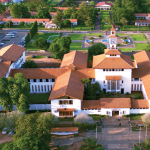
He made the remarks at the “Time with a Politician” conference organised by the Department of Political Science at the University of Ghana, in partnership with the Konrad-Adenauer-Stiftung (KAS), held on Thursday, June 4, 2026, at the Kofi Drah Conference Room.
At the event, he reflected on a tense episode in his political career triggered by controversy surrounding comments he made about the Asante State.
He recounted that false narratives circulated at the time nearly escalated tensions, culminating in an unexpected encounter involving the Asantehene, Otumfuo Osei Tutu II, during a visit in London.
“A few months after the controversy, Otumfuo went to London and was visiting the British Museum. When I entered to greet him and show my support, there was a gentleman sitting next to him. This gentleman started talking about everything that had allegedly been done against the Asante State, warning that if I ever made a mistake, he would personally ensure my political career was ended,” he recounted.
He further described an unexpected turn of events when the individual accused of spreading the claims later walked into the same room.
“God is so good; the person who went to tell him those things entered right then,” he said.
“So, he was asked, ‘You came to tell me NAPO said this—what exactly did NAPO say?’ The man suddenly collapsed. By the time we were returning, the man had actually ended up in the hospital.”
Reflecting on the incident,Dr. Prempeh stressed the importance of caution in political communication and urged actors in the political space to avoid misinformation and misrepresentation of facts.
“I accept the fact that in political communication, you have to be very careful,” he noted.
“That is why I went to the Kumasi Traditional Council to explain exactly what I meant. The chiefs didn’t even ask me to apologise because they realised how I had actually said it. The statement itself was not wrong; it was simply how it had been interpreted by people with specific motives in a certain political dimension,” he added.
He concluded by urging political actors and the public to prioritise fact-checking over propaganda in order to safeguard political stability and social cohesion.
–
Story by Abraham Aboagye | univers.ug.edu.gh
Edited by Erica Odeenyin Odoom