
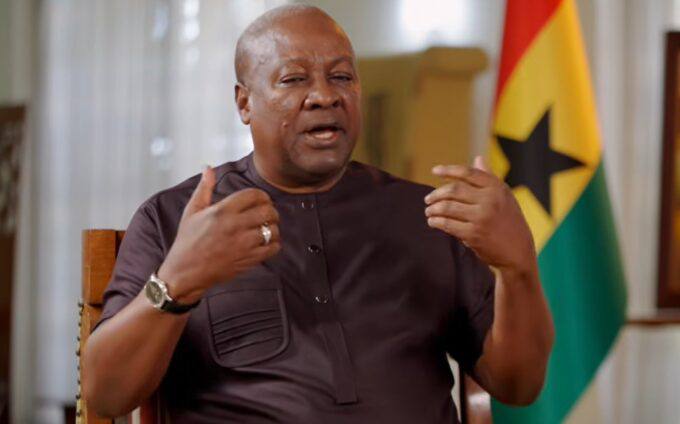
President John Dramani Mahama has directed the Minister of Finance, Dr. Cassiel Ato Forson, to allocate GH¢1 billion to the National Housing Fund in the 2027 Budget as part of efforts to bridge Ghana’s housing deficit through collaboration between the government and the private sector.
The development follows a two-day National Housing Conference organised by the National Housing Fund and its partners from 7 to 8 October in Accra to work out plans of bridging the financing gap and other challenges that affect affordable housing delivery in Ghana.
Speaking at the event held at the Mövenpick Ambassador Hotel in Accra as Guest of Honour, President Mahama said that the allocation will be placed into the coffers of the National Housing Fund on a revolving basis to finance housing projects in the country, with a focus on making them affordable to Ghanaians across different income levels.
“I have given indication to the Honourable Minister of Finance, Dr. Ato Forson, to take out GH¢1bn from the Consolidated Fund to the coffers of the National Housing Fund to be captured in the 2027 Budget as part of efforts to liaise with the private sector to set up a GH¢3bn Housing Fund in total that will be used to finance housing projects on affordable and flexible rates to enable the ordinary Ghanaian families to get decent accommodations to live in and get productive for the total development of our country.”
“This is the way of the state stepping in to provide a social policy that cushions the lower ends of the population like those mainly on the informal sector as well as other sectors of the economy to be able to afford houses on their own terms over time without being unnecessarily burdened financially,” he said.
He also urged financial institutions to be mindful of the economic conditions of the larger population with respect to being able to access credit to acquire decent housing and develop policies to reflect such realities.
“A large section of our people are not too wealthy and comfortable with the salaries they earn and as such banks and other financial institutions must be more sensitive to the plight of those persons by making available easier terms of mortgage and credit to help them acquire properties over time as they work to support the country’s economy.”
“Per official records, Ghana’s housing deficit stands at a staggering 1.8 million housing units due to a myriad of factors including expensive and punitive mortgages, high unemployment, cost of building materials as indexed against the dollar and other compelling social factors that compound the problem,” he said.
As part of efforts to address the issues, the National Housing Fund’s existing mortgage interest rate has been reduced from 13.5 per cent to 8.4 per cent, while developer credit financing under the scheme stands at 10.4 per cent.
Available data indicates that close to 1,000 people have benefited from the scheme by gaining access to decent housing.
The next phase is expected to be supported by the GH¢3 billion fund, which will be established in collaboration with private-sector stakeholders.
In a related development, the President also announced another initiative dubbed “Easy Rent”, which seeks to reduce the burden of large upfront rental payments in the country’s housing sector.
Under the new initiative, the National Housing Fund will make rental payments upfront for eligible workers, who will subsequently pay in monthly instalments.
Easy Rent is expected to complement the government’s flagship National Rent Assistance Scheme, which seeks to cushion ordinary Ghanaians, particularly young workers, from the burden of upfront rent payments and additional agency charges. These expenses often consume a significant portion of their modest salaries, leaving them with little to invest in other important areas of their lives.
President Mahama also shared a personal story about his initial struggles to secure decent accommodation in his younger years after moving out of his father’s property with his wife, Lordina Mahama, to settle in Madina, Accra.
He shared this to highlight how the experience remains one of his key motivations behind his government’s efforts to introduce policies aimed at making decent and affordable housing accessible to Ghanaians.
–
Story by Sika Togoh | univers.ug.edu.gh
Edited by Vanessa Katrin Ohene