

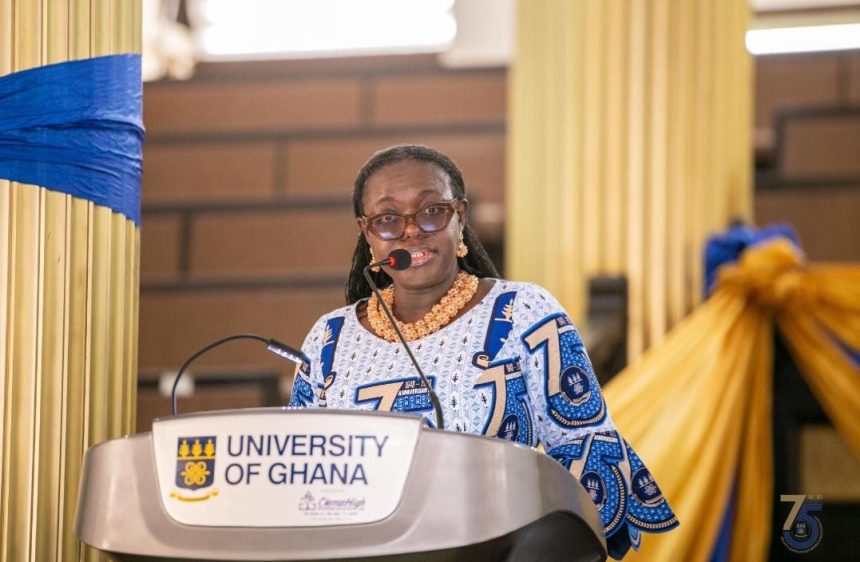
Professor of Linguistics and Vice-Chancellor of the University of Ghana, Nana Aba Appiah Amfo, has stated that language is a critical driver of social change in human societies.
The first female Vice-Chancellor of the premier university made this remark at the Ghana Academy of Arts and Sciences during an inaugural lecture held in her honour on April 23, 2026, following her election as a Fellow in 2021.
Speaking on the theme “Reclaiming Voice in the Global Order: Language, Gender and the African Academy,” Prof. Amfo noted that language, in its various forms and dialects, has shaped many aspects of human civilisation over time and fostered strategic interactions in society.
“Languages are critical nerve centres of human societies in building cultures and practices over time that have propelled development across many parts of the world.
“That phenomenon cuts across politics, economics, business, and education, which are key pillars in transforming societies across generations,” she said.
The linguist also raised concerns about what she described as a worrying trend in the global knowledge production system, where indigenous knowledge from countries in the Global South must meet narrow standards set by Western institutions to gain formal recognition.
She noted that such unequal power relations undermine the recognition of quality scholarly work produced by researchers from the Global South.
“In our educational landscape, especially in higher education institutions, we have over the years allowed Western institutions and agencies to define, according to their standards, what qualifies as scholarly work.
“Even in our schools, academic work on indigenous knowledge from the Global South is often considered incomplete without endorsement from external bodies. This is a disservice to scholars in the Global South and disproportionately affects African researchers and their progression into positions of influence both locally and internationally,” she stated.
She further proposed measures to address the issue.
“We must redefine the scope of what is considered valid in global knowledge production, particularly as it relates to indigenous contexts. Continued advocacy through perspectives such as gender and equitable resource allocation will help amplify Africa’s voice on the global stage over time,” she added.
Chair for the occasion, Emerita Professor Isabella Akyinbah Quakyi, underscored the importance of language and gender perspectives as foundations for advancing African scholarship beyond national boundaries.
“In many organised societies, communication and social interaction are underpinned by language. It is therefore essential to redefine language beyond national boundaries to remain relevant in global discourse on economic and socio-political development,” she said.
The well-attended event drew participation from Senior Fellows of the Academy, government officials, academics, members of the University community, selected journalists, students from Labone Senior High School, Presbyterian Boys’ Secondary School, and Accra Girls’ Senior High School, as well as members of the general public.
—
Story by Sika Togoh | univers.ug.edu.gh
Edited by Gabriel Tecco Mensah