

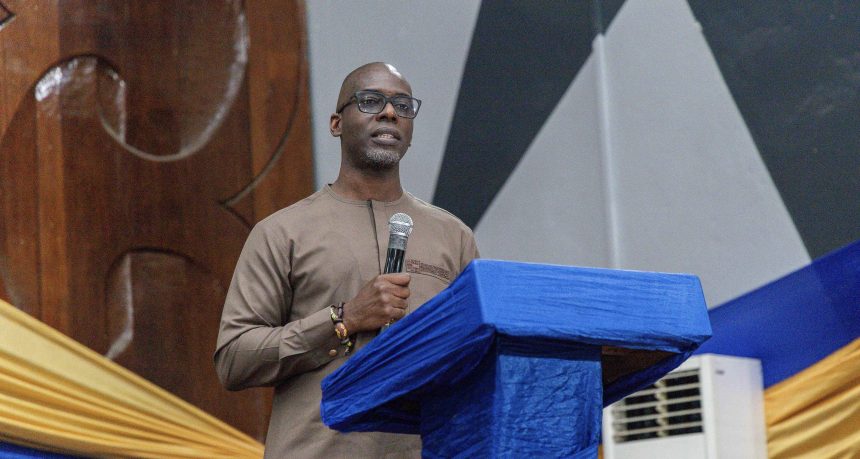
Consultant and Advisor on Emerging Technology Strategy and Risk Governance, Kofi Dadzie, has warned that an emerging “intelligence outbreak” is rapidly transforming the global economics of knowledge and skills.
Speaking at the University of Ghana Business School (UGBS) 46th Management Week Celebration on Wednesday, June 24, 2026, he cautioned that Ghana’s services sector faces significant disruption, urging academia and corporate human resource managers to act swiftly to safeguard and reposition local talent.
He noted that much of the analytical and knowledge-based work currently taught in universities can now be completed within minutes by artificial intelligence systems.
“Much of the content, the analytical skills, what for students here and faculty you’ve been teachin most of that work can be rendered in tokenized minutes by AI agents,” he stated.
Dadzie encouraged students and professionals to shift focus toward higher-order thinking and judgment-based skills.
“Become the one who can ask better questions, frame better problems, exercise judgment, preserve dignity, and decide not only what ought to be done, but what should never be surrendered,” he added.
He introduced the concept of “token capital” to describe human knowledge converted into machine-readable data, arguing that Ghana must strategically manage its data resources under its National AI Strategy.
“The idea is it’s reserved so that it can compound Ghanaian capability rather than quietly reduce the need for it,” he explained.
He asserted that unlike human labour, AI systems do not require benefits such as pensions or leave, stressing that human resource management must evolve in the age of automation.
“If talent now means human capital, then someone must be charged with growing it. This is why HR is not a supporting function in the age of AI,” he noted.
Cautioning against traditional “reskilling” approaches that struggle to keep pace with technological advancement, Dadzie referenced the Parable of the Talents to emphasise the need for active innovation and productivity.
“The servant who buried his talent in the ground for safekeeping wasn’t praised. He was rebuked for failing to make it bear fruit,” he said.
He added that failure to adapt would allow others to commercialise missed opportunities.
“Now, bury your talent today, and somebody else will dig it up and sell it back to you as a subscription,” he warned.
Dadzie advocated a shift from employability to entrepreneurship, stressing that enterprise-driven thinking is key to economic transformation.
“Employability may keep you in the game. Enterprise, however, can change the score,” he stated.
He urged organisations to ensure that artificial intelligence augments human labour rather than replacing it, cautioning against job cuts driven solely by short-term efficiency gains.
“Productivity bought at the price of people is a loan. It’s not a profit,” he cautioned.
Concluding, he challenged the University of Ghana Business School to prepare students not only to survive technological disruption but to actively shape it.
“The question is not which skills AI cannot touch, but what you intend to do with the ones that it can impact,” he emphasised.
–
Story by Wilhemina Dushie | univers.ug.edu.gh
Edited by Erica Odeenyin Odoom