

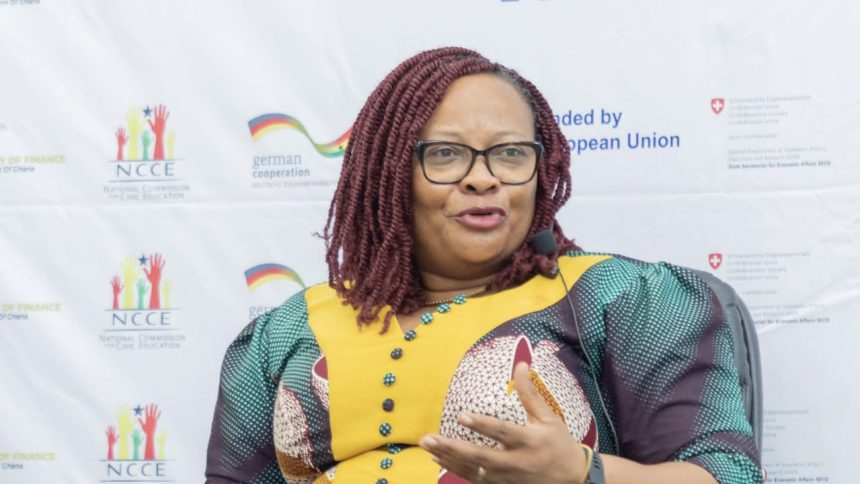
The National Commission for Civic Education (NCCE), with support from the European Union (EU) and GIZ, has engaged tertiary students in a Youth-Led Dialogue on the rule of law, accountability and the fight against corruption.
The dialogue was held on Friday, August 14, 2026, at the West Africa Centre for Crop Improvement (WACCI), University of Ghana.
Held under the theme “Rule of Law and the Fight Against Corruption Project,” the programme brought together students and leaders from six tertiary institutions, including the University of Ghana (UG), University of Media, Arts and Communications (UniMAC), Korle Bu Medical School, University of Professional Studies, Accra (UPSA), Ghana Communication Technology University (GCTU) and Heritage Christian University.
The session provided a platform for participants to discuss transparency, accountability, ethical leadership and the role of young people in promoting good governance.
Speaking at the forum, Executive Director of Transparency International Ghana, Mrs. Mary Addah, stressed the need for consistency and careful consideration when dealing with ethical dilemmas.
“When it comes to ethical considerations, we need to be very careful and also we need to ensure consistency. And so wherever you find yourself in such an ethical dilemma, there is a test to ensure that you take yourself out of the process,” she said.
Mrs. Addah also clarified that taking loans does not in itself constitute corruption, explaining that borrowing is a common means of financing development when a country’s internally generated resources are insufficient.
“Loans are not bad. We need to take loans. Every country takes loans. The United States of America still owes. So there is no country in the world where they’ll say as for us, we’re satisfied, we don’t want money again for development,” she explained.
She, however, cautioned against the misuse of borrowed funds, particularly when corruption influences the process of securing loans or results in portions of the funds ending up in private hands.
“The loans are supposed to facilitate a certain process to drive development. In a country, we need budgets and the budget can be funded by the resources we mobilize. And so in the mobilization of these resources, we realize that at the end of the day, what we should have been able to mobilize are short. So it means there’s a gap and the deficit can only be breached if we look for other sources and those other sources is usually will be for us through the loans that we procure,” she said.
She further called for stronger measures to ensure that loans contracted by the state are used for their intended purposes.
“We need to take loans to develop but in the space where the huge appetite for taking loans to propagate corruption in our country is what we should be curtailed. The taking of loans, some percentages ends up in people’s pockets because they facilitate the process, they get financial engineers to facilitate these processes and they get so much from that,” Mrs. Addah stated.
Mrs. Addah also urged Ghanaians to contribute to the fight against corruption by promoting transparency and demanding stronger systems of accountability.
“We can do so as other countries have done. Let’s be transparent, let’s put in place very stringent protocols for engaging in these contractual agreements. If we’re taking loans, we should put in place benchmarks, laws that spell out clearly who can do this, and what is allowable and what is not allowable. And also put in place very strict enforcement measures so that if it is not complied with, then we can sanction them,” she added.
The dialogue forms part of efforts to equip young people with the knowledge and confidence to participate in discussions on governance, accountability and the rule of law, while encouraging them to play an active role in combating corruption.
–
Story by Abigail Adubofour | univers.ug.edu.gh
Edited by Erica Odeenyin Odoom