

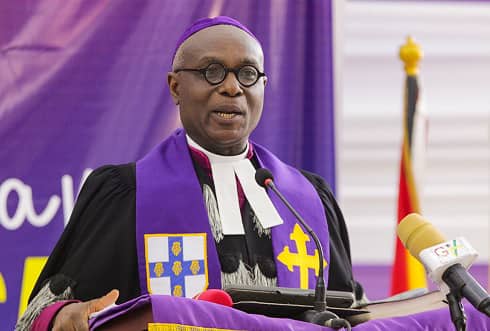
The Presiding Bishop of the Methodist Church Ghana, Most Reverend Professor Johnson Kwabena Asamoah-Gyadu, has attributed the spread of corruption into religion to the growing decline in public confidence in Ghana’s political order.
He made the remarks on Tuesday, July 28, 2026, during the opening day of a three-day conference organised by the Department for the Study of Religion at the University of Ghana at the Centre for Biodiversity and Conservation Research.
The conference was held on the topic, “Speaking for God in the Public Sphere: A Religio-Theological Inquisition into Christianity, the Prophetic and Governance in 21st Century Africa,” under the main theme, “Political Prophecies in Post-Secular Ghana.”
The conference examined the growing intersection of religion, politics and governance, particularly the role and influence of Christian prophetic ministry in public life.
According to Most Reverend Professor Asamoah-Gyadu, political prophecy has long been part of Ghana’s socio-political and religious landscape and is unlikely to disappear.
“In Ghana, prophetic politics is not a new phenomenon, as I have pointed out, and it does not look like it will evaporate from our sociopolitical and religious lives anytime soon,” he said.
He explained that the declining confidence in political leadership and democratic institutions has contributed to the spread of corruption beyond governance structures into other areas of society, including religion.
“Christian leadership, therefore, has been complicit in the erosion of confidence in Ghana’s political apparatus. In Ghana today, corruption has eaten into the fabric of every facet of our society. This includes religion, and the way faith is articulated and expressed in very corruptible, morally permissive, and politically partisan ways,” he stated.
Most Reverend Professor Asamoah-Gyadu further expressed concern about the increasing politicisation of prophetic ministry, particularly the involvement of some religious figures in predicting election outcomes and engaging in partisan activities.
“The Ghanaian public openly complain about how persons claiming a Christian prophetic calling, for example, now specialise in predicting the outcomes of elections, sometimes in very contradicting ways,” he said.
Drawing from his experience as the head of the Methodist Church Ghana, he noted that accountability within established church structures helps prevent irresponsible prophetic declarations.
“Just in the past three or four months or so, I’ve had occasion to invite three Methodist ministers to the office to explain to me things they put on social media, because they are accountable to a higher authority, so they will think before they prophesy,” he said.
He added that some Christian leaders, particularly those operating outside established ecclesiastical structures, have contributed to the decline in public trust in both religion and governance.
“Unfortunately, some Christian leaders, especially those not accountable to centralised ecclesial bodies and operating independently of historic mission denominations, have become complicit in the erosion of public confidence in the political order,” he said.
He warned that the misuse of prophetic ministry has weakened its credibility and affected how the public perceives the role.
“The erosion of confidence in the prophetic order has occurred through political patronage for personal gain and the use of prophetic utterances to prop up acts of corruption in the push for the realisation of partisan political interests.”
He further lamented that the abuse of prophetic ministry has diminished its relevance in contemporary Christianity.
“This ministry, which is very coveted in contemporary Christianity, has unfortunately deteriorated into nonsensicality to the child brain of critical minds and objective watchers and commentators of Ghanaian democracy.”
–
Story by Emmanuella Ntowbea Marbell | univers.ug.edu.gh
Edited by Erica Odeenyin Odoom