
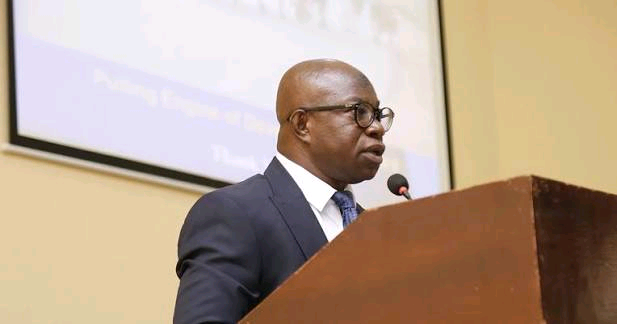
Professor of Population and Medical Geography at the University of Ghana, Samuel Agyei Mensah, has stated that inter-ethnic and interracial marriages have played a significant role in shaping the social fabric of contemporary Ghanaian society and promoting national cohesion.
He made the remarks during the 2026 Annual Humanities Lecture organised by the Ghana Academy of Arts and Sciences on the theme, “Interracial and Inter-Ethnic Marriages in Accra.”
Addressing participants at the lecture held on Thursday, May 14, 2026, Professor Agyei Mensah explained that data from the 2000 Population and Housing Census revealed that a substantial proportion of marriages in urban centres, particularly Accra, were inter-ethnic in nature. According to him, this reflects the extent to which Ghana’s diverse ethnic groups have developed strong social ties over the years.
He noted that some ethnic groups, particularly the Ga and Ewe communities, appeared more open to marrying across ethnic lines compared to the Akan ethnic group, where considerations such as family traditions, inheritance systems, lineage preservation, education, and socioeconomic status often influence marital choices.
“The data suggests that ethnic groups such as the Ga and Ewe are generally more likely to enter inter-ethnic unions, while among Akan communities, factors such as family ties, cultural traditions, inheritance systems and social expectations often encourage marriages within the same ethnic or linguistic group,” he explained.
Professor Agyei Mensah further observed that outside major urban centres, many Akan communities tend to favour marriages within their own regions and dialect groups as a means of preserving cultural traditions, family heritage, and established systems of inheritance.
He, however, emphasized that marriage patterns across Ghana remain diverse and are influenced by a range of social, cultural, and economic factors, reflecting the country’s rich ethnic composition and longstanding tradition of coexistence.
“Different ethnic groups attach varying levels of importance to factors such as culture, language, social status, and family expectations when choosing life partners. These differences contribute to the unique character of Ghanaian society and demonstrate how diversity has become one of our greatest strengths as a nation,” he said.
Professor Agyei Mensah also highlighted the role of geography, urbanisation, education, and occupational mobility in fostering inter-ethnic and, in some instances, interracial marriages.
According to him, increasing levels of education and urban migration have expanded social networks and interactions among people from different backgrounds, creating greater opportunities for cross-cultural relationships and marriages.
“Like many modern societies, the prevalence of inter-ethnic marriages in Ghana is shaped by a combination of factors, including residential patterns, language, educational attainment, and occupation. Evidence suggests that individuals with higher levels of education and those living in cosmopolitan urban environments are generally more likely to marry outside their ethnic groups than those in more homogeneous communities,” he noted.
He further called for more comprehensive and systematic analyses of population data to better understand the evolving dynamics of marriage and family formation within Ghana’s increasingly diverse urban population.
In a related development, Chairperson for the occasion, Emerita Professor Takyiwaa Manuh, underscored the importance of understanding the relationship between ethnic identity, social status, and marriage in fostering national unity and peaceful coexistence.
She noted that historical records from both the colonial and post-independence eras reveal longstanding patterns of marital relationships that crossed ethnic and racial boundaries, helping to strengthen social, cultural, and economic ties within Ghana and beyond.
“Historical evidence demonstrates that inter-ethnic and interracial marriages have been part of Ghana’s social history for generations. Relationships between local populations and Europeans during the colonial era, as well as marriages among various ethnic groups, contributed significantly to shaping the country’s social and cultural identity,” she said.
Professor Manuh stressed the need for scholars, researchers, and institutions to document these historical experiences and preserve them for future generations.
“There must be a conscious effort to compile and preserve these records as part of our national history. Understanding how different communities interacted, formed families, and built relationships across ethnic and racial lines is essential to appreciating the foundations of Ghana’s unity and diversity,” she added.
The lecture brought together students from Presbyterian Boys’ Secondary School, journalists, Fellows and members of the Ghana Academy of Arts and Sciences, academics, and members of the general public.
The event formed part of the Academy’s efforts to promote scholarly discussion on issues of national importance and deepen public understanding of Ghana’s social and cultural development.
–
Story by Sika Togoh | univers.ug.edu.gh
Edited by Erica Odeenyin Odoom