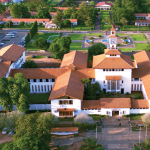

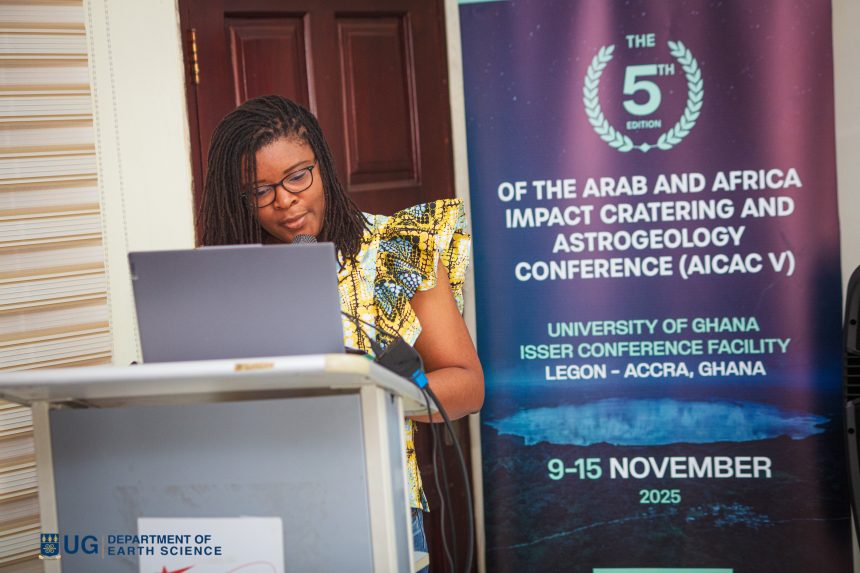
The 5th edition Arab and Africa Impact Cratering and Astrogeology Conference has been held at the premises of the Institute for Statistical, Social and Economic Research (ISSER) at the University of Ghana in Accra.
The event aimed to bring together seasoned geologists and mid-level professionals to explore findings in space science and disseminate information to guide policy and decision-making across various sectors.
Speaking in an interview with Univers News on the sidelines of the event, the Convener, Dr. Marian Selorm Sapah of the Earth Science Department, said the main goal of the conference is to mainstream planetary and space science on the African continent, generating governmental support and resources to train the next generation of planetary scientists and develop expertise in this high-level sector.
“The idea behind the 5th edition Arab and Africa Impact Cratering and Astrogeology Conference, is to make planetary and space science more visible and integrated into educational and policy frameworks, not only in Ghana but across Africa,” she noted. “A key focus is on training and capacity building for the next generation of African planetary and space scientists to secure both state and corporate support for this resource-intensive field.”
Dr. Sapah further explained to Univers News that “impact cratering” refers to the phenomenon when objects from space hit the Earth’s crust and create an impact site. She cited Lake Bosumtwi in the Ashanti region as an example, where a meteorite impact formed a crater later filled by water as part of a natural occurrence.
She also noted that cosmo-chemistry, a branch of geology, studies the composition of meteorites to determine whether they share characteristics with naturally occurring Earth rocks, aiding research and knowledge dissemination.
“When meteorites and other space objects strike the Earth’s crust and form craters, this is termed ‘impact cratering’ in geology,” she explained. “Lake Bosumtwi in the Ashanti Region was formed this way, with the crater subsequently filled with water. Such natural sites provide opportunities for researchers to conduct analytical investigations that advance scientific understanding.”
The conference featured a pre-conference workshop, multiple research paper presentations, remarks from University management, and participation from sister research agencies including the Ghana Atomic Energy Commission and the Ghana Space Science and Technology Institute.
Additional activities included poster presentations, star gazing experiences for attendees, and a field trip to the Lake Bosumtwi site to deepen participants’ understanding of recent research discoveries.
Notable guests included Professor Christian Koerbel (University of Vienna), Professor Hasnaa Chennaoui Aoudjehane (Hassan II University of Casablanca), Dr. Nicholas Mangold (France), among other distinguished personalities.
–
Story by Sika Togoh | univers.ug.edu.gh
Edited by Gabriel Tecco Mensah