

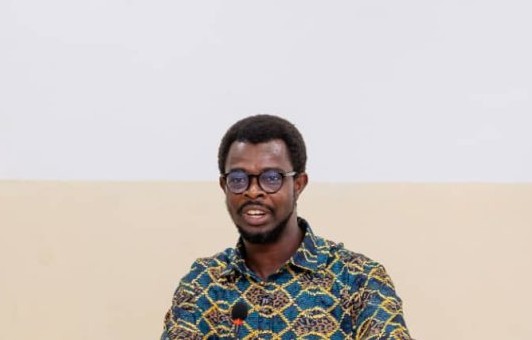
Architect of metanomics and Bank of Ghana Chair in Finance and Economics, Professor Paul Yegandi Imhotep Alagidede, has proposed a bottom-up economic framework to help students turn their talents into funding opportunities.
Speaking to Univers News during the Metanomics and Tokenisation Seminar held at the Cedi Conference Centre on Wednesday, June 17, 2026, Professor Alagidede argued that traditional economic structures often concentrate wealth at the top, making it difficult for capital to reach people at the lower end of the economic ladder.
“The kind of economics that we operate now is actually inequality, which is the basis of it. Because when a few people sit at the top and print and control the money supply, it makes it very difficult to get down to the bottom,” Prof. Alagidede stated.
He said metanomics and tokenisation could offer an alternative approach by recognising individual capabilities as assets that can be assigned value and potentially used to raise capital.
“We are a bottom-up approach actually, so even the student’s wealth can be tokenized. Your knowledge, whether you are in first year, second year, third year, it doesn’t matter, you already have an asset, you are already a business on your own,” he explained.
Prof. Alagidede said the proposed framework could benefit students across different fields, including those pursuing academic careers and those building careers in creative industries.
He explained that students could potentially use their talents and other assets to access funding without relying solely on traditional financing options such as bank loans.
“So with these proposals, you have the means; if you have a music career, it can be tokenized. If you have an asset or a talent in the university, that already can be tokenized to help you to raise money to do whatever you want to do,” he said.
He further revealed that the broader goal of the approach is to reduce economic inequality by creating opportunities for individuals at different levels of society to participate in wealth creation.
“So our proposal is actually zero inequality, although some people say that cannot exist, but minimal inequality, so to speak,” he added.
–
Story by Wilhemina Dushie | univers.ug.edu.gh
Edited by Erica Odeenyin Odoom