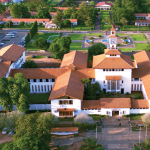

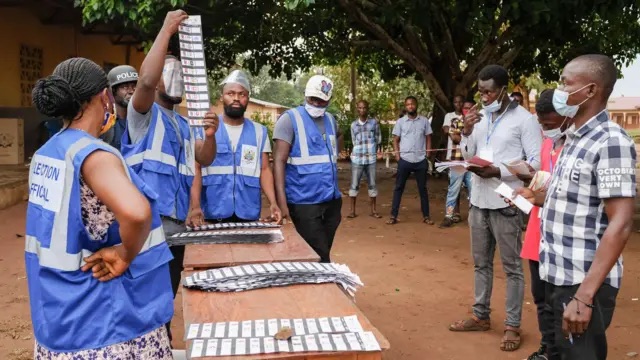
The 2025/26 UGSRC general elections have taken a major turn that many students did not anticipate.
In a communique released by the Electoral Commission on August 21, 2026, the Commission stated that one of the presidential aspirants, Mr. Abednego Lomazah, did not meet the required CGPA threshold following the verification of his academic qualifications by the Dean of Student Affairs.
In accordance with Article 30(1)(b) of the UGSRC Constitution and Article 4(e)(iii) of the Constitutional Instrument (C.I. 26), the presidential and vice-presidential ticket of Abednego Lomazah and Samuel Espan Bissah was consequently disqualified from contesting the 2026 UGSRC elections.
But why does the disqualification of a presidential aspirant represent such a major turn in the 2025/26 UGSRC elections?
Article 29(2) of the UGSRC Constitution states:
“The election of the Executive Officers shall be on the terms of secret popular vote and shall, subject to the provisions of this Constitution, be conducted in accordance with such regulations as may be prescribed by Constitutional Instrument issued by the Electoral Commission.”
However, in a communique released by the Electoral Commission on August 20, 2026, only two presidential tickets were declared eligible to contest:
1. Abraham Kofi Amudzegbe and Evanda Nana Agyenim Boateng
2. Abednego Lomazah and Samuel Espan Bissah
With the disqualification of the second ticket, the presidential election will now be contested by only one ticket. This effectively makes Abraham Kofi Amudzegbe and Evanda Nana Agyenim Boateng unopposed.
But is an unopposed presidential race something new to the UGSRC?
According to a report by Gloria Nyarku published by ModernGhana on April 20, 2015, the 2014/15 UGSRC presidential election was contested by Joshua Dogbe unopposed. Dogbe’s unopposed election was subsequently challenged in court, with petitioners arguing that it was unconstitutional for him to run unopposed. The court initially upheld the petition, but the decision was later reversed on appeal, allowing Dogbe to remain in office.
A separate report published by 233 Live News on March 27, 2014, reported that Dogbe and his running mate, Joshua Andrews-Agyir, secured 3,246 YES votes against 388 NO votes in the election.
This history shows that an unopposed presidential race is not entirely new to UGSRC elections.
So, a student may ask: why do unopposed races hardly happen at Legon?
Student politics at the University of Ghana is traditionally intense, highly competitive and crowded. The scarcity of unopposed presidential races can be attributed to several factors.
To begin with, there is significant interest in the UGSRC presidency. It is a highly sought-after position, and multiple campus factions and influential student groups often produce competing candidates, ensuring that several aspirants file nominations each year.
Secondly, history has shown that disqualification decisions can be challenged through legal and electoral processes. Even when the Electoral Commission attempts to disqualify prominent contenders, those decisions are not necessarily final. A notable example was the 2024 election involving Ghanaian musician Guru, alias Maradona Adjei Yeboah, whose initial disqualification was overturned, allowing him to remain in the race.
Finally, interim measures have been put in place in the past. In situations where vetting disputes or legal injunctions significantly disrupt the electoral process, university management may resort to interim arrangements rather than proceeding with an uncontested election. The 2019/20 SRC administration is one example.
In a nutshell, the 2026 UGSRC presidential race is set to be unopposed, making it the second documented instance in available records of a UGSRC presidential race being contested by only one ticket.
The last time this happened, Joshua Dogbe’s unopposed election became the subject of a legal challenge before ultimately being upheld on appeal. Whether history repeats itself this year, however, will ultimately be decided by the students of the University of Ghana.
—
Story by Chrispin Xavier Agyekum |univers.ug.edu.gh
Edited by Anita Azawodie