
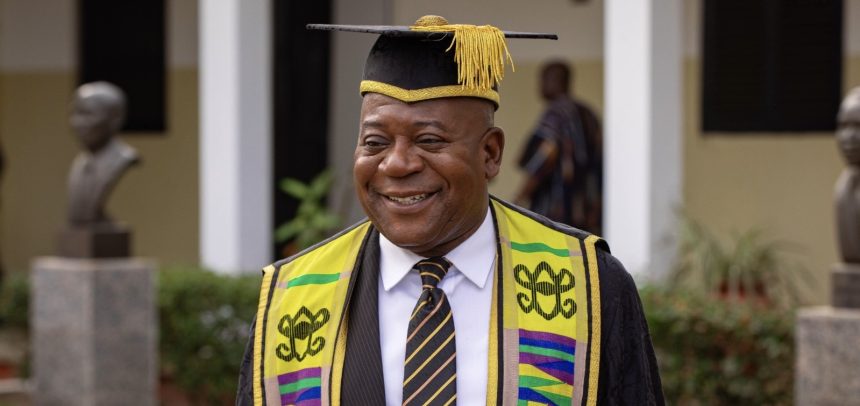
The newly appointed Pro Vice-Chancellor for Research, Innovation, and Development (RID) at the University of Ghana (UG), Professor Samuel Nii Ardey Codjoe, has praised the government for creating the Ghana National Research Fund, describing it as a major step towards strengthening academic self-reliance.
His commendation comes amid long-standing concerns over the heavy reliance on international donor funding, much of which has experienced significant budget cuts in recent years, leaving local institutions struggling to sustain critical research projects.
He spoke on Radio Univers’ Campus Exclusive show.
“Let me commend this government on the establishment of the Ghana National Research Fund,” he stated.
He noted that local researchers have relied on foreign funding for too long, even as many international funding sources continue to decline.
“For a long time, academics have been talking about the fact that we always have to go outside to look for funding and compete for funding, and these days, some of the funding sources are drying up,” Prof. Codjoe said.
He cited recent reductions in international research funding, particularly in the United States.
“If you take the case of the US, they’ve cut a lot of the funding,” he explained.
Prof. Codjoe argued that increased government investment in research would enable Ghana to determine its own research priorities.
“So it’s about time that our own government also became interested in funding research so it can set the research agenda,” he emphasised.
Beyond national research funding, Prof. Codjoe revealed that the University of Ghana is expanding research opportunities at the undergraduate level by establishing research and surveillance sites across four ecological zones in the country: the coastal, forest, transitional, and savannah belts.
“The University is moving heavily into undergraduate research,” he revealed.
“As part of my vision, we are trying to establish what we call research and surveillance sites in key localities across the country—one in the coastal belt, one in the forest belt, one in the transitional belt, and one in the savannah belt,” he added.
He explained that exposing students to fieldwork would provide them with valuable practical experience and strengthen their research skills.
“When this happens, we will arrange for students to go into the field and participate in these activities so they can gain the experience,” Prof. Codjoe said. “I believe this is a skill that some of them can use in their future endeavours.”
Prof. Codjoe stressed that introducing students to research early in their academic journey is essential to building local research capacity and ensuring the long-term growth of Ghana’s research ecosystem.
“We’ll bring in a lot of early-career people, such as students. If you catch students young and get them excited about research, I think that’s the future. For me, the future is very bright.”
—
Story by Wilhemina Dushie | univers.ug.edu.gh
Edited by Gabriel Tecco Mensah