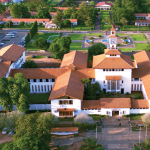

For Jonas Nyabor, journalism did not begin in a high-profile newsroom or an international media organisation. It began at Radio Univers — the student-run campus station that helped shape his understanding of journalism, community engagement, and public responsibility.
Today, the former Radio Univers volunteer is pursuing graduate studies in the United States at University of Iowa, where his research focuses on emerging technologies, misinformation, and the future of journalism in West Africa. Yet, despite the transition from campus radio to academia abroad, Nyabor says the foundational lessons from Radio Univers continue to guide his work.
Radio Univers and the Making of a Journalist
According to Nyabor, Radio Univers provided much more than technical training. It became the environment where he first learned the values that would define his journalism career.
“Working at the radio station not only taught me important lessons about clarity, curiosity, and connecting with ordinary people through meaningful conversations, it also gave me practical confidence very early on,” he told Radio Univers.
He credits the station for teaching him teamwork, audience awareness, and responsibility at a formative stage in his career. Those early experiences, he explained, later inspired his own commitment to mentoring younger journalists and student reporters.
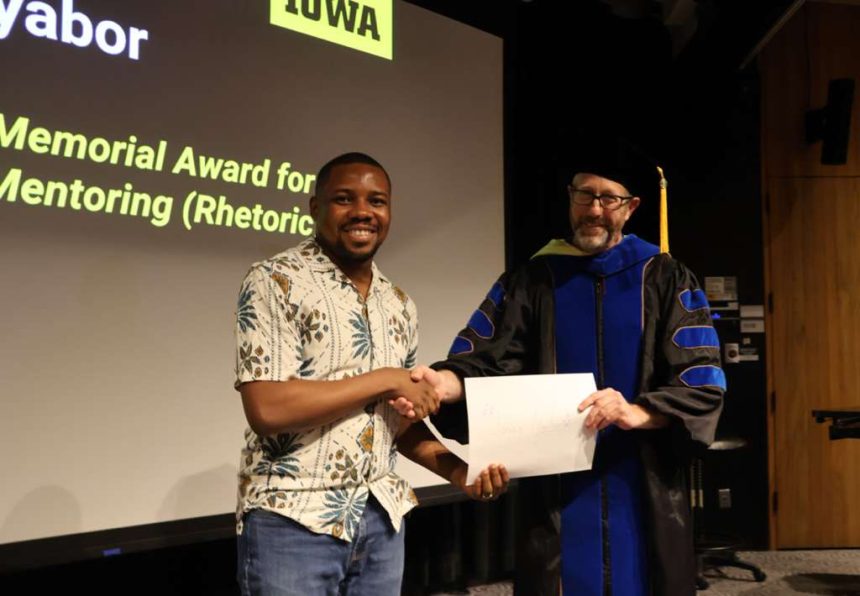
Nyabor, who has received the 2026 Doug Trank Memorial Award for Excellence in Teaching and Mentoring from the University of Iowa, also noted that his time at Radio Univers deepened his appreciation for community-centred journalism — an approach that continues to shape his current academic and professional interests.
Beyond reporting and research, he said he has become increasingly interested in how journalism can help people navigate today’s complex information environment. This has informed his growing interest in media literacy and community-focused projects.
Currently, he is exploring a community media literacy initiative in the state of Iowa designed to help senior citizens and non-native English speakers identify misinformation and better understand digital information systems.
Why He Chose Graduate School
After spending more than a decade working across community, national, and international media platforms, Nyabor said he reached a point where deeper reflection became necessary.
He described journalism as a profession undergoing a profound transformation due to technological disruption, including the rise of social media, artificial intelligence, and online misinformation.
“Experiencing firsthand the impact of these developments on audience trust, journalistic authority, and media sustainability prompted me to reflect more deeply on the profession and its future,” he explained.
For Nyabor, graduate school became an opportunity to critically examine the theoretical foundations of these changes and better understand what they could mean for journalism in Africa.
“I was at the point in my career where I believed there was the need to pause and critically reflect,” he said, adding that pursuing graduate studies has been a decision he is glad he made.
The Realities of Studying Abroad
Nyabor also challenged the “romanticised” perception many people hold about studying abroad.
While acknowledging the opportunities available in international academic environments, he emphasised that the experience comes with significant personal and professional adjustments.
“You are dealing with constant adjustments, uncertainties, financial pressure, navigating unfamiliar systems and of course homesickness,” he said.
According to him, studying abroad does not automatically make someone more knowledgeable or successful. Rather, it simply presents a different learning environment with its own opportunities and challenges.
Transitioning from professional journalism into a research-based academic setting has also required adaptation. Although he sometimes misses the pace and immediacy of newsroom work, he says certain academic activities — particularly interviews and collaborative problem-solving — still provide familiar journalistic experiences.
Nyabor noted that journalism practice abroad can be difficult to immediately integrate into because reporting often depends heavily on local cultural understanding and networks. However, he stressed that the core principles of journalism remain universal.
“Verification, transparency, and accountability cut across,” he said.
At the University of Iowa, he says access to academic resources, supportive faculty, and diverse international classmates has enriched his learning experience. Still, he maintains that journalism ultimately remains a practical profession.
“No academic environment fully prepares you for the realities of the journalism profession,” he said. “Journalism is still something you learn by doing, adapting, and staying engaged with communities.”
Advice to Young Journalists
To students and aspiring journalists hoping to study abroad, Nyabor’s message is simple: pursue the opportunity strategically and focus on growth rather than prestige.
“Focus less on prestige and more on practice,” he advised.
He encouraged young journalists to read widely, remain curious, and commit seriously to the craft, stressing that good journalism is not defined by where one studies but by how deeply one engages with the profession.
Looking Ahead
Nyabor’s current work centres on how emerging technologies are reshaping journalism in West Africa, particularly their impact on newsroom practices, labour, credibility, and the future sustainability of journalism in the region.
He is also continuing to explore community-centred media literacy initiatives aimed at helping vulnerable populations navigate misinformation and digital manipulation.
His journey — from student volunteer at Radio Univers to journalism researcher in the United States — stands as a reflection of how campus media platforms can nurture not only careers, but also long-term commitments to public service journalism and community engagement.